# Portfolio Construction for VCs - EUVC Podcast
Read, listen & watch for learnings on dynamic modeling, reserve allocation, probabilistic vs deterministic models, optimum fund sizes and modeling things like RVPI conversion to DPI & using hard data
| [Listen · 1HR 10M](https://substack.com/app-link/post?publication_id=592258\&post_id=133090875\&utm_source=podcast-email\&play_audio=true\&token=eyJ1c2VyX2lkIjoxMDYxMTk3NTQsInBvc3RfaWQiOjEzMzA5MDg3NSwiaWF0IjoxNjkwMjYxMzk1LCJleHAiOjE2OTI4NTMzOTUsImlzcyI6InB1Yi01OTIyNTgiLCJzdWIiOiJwb3N0LXJlYWN0aW9uIn0.fp93wUUC-hwRmvPS0g6XIWxXIXRk-55excG3dyXw5cs\&utm_source=substack\&utm_medium=email#play) |
| :---------------------------------------------------------------------------------------------------------------------------------------------------------------------------------------------------------------------------------------------------------------------------------------------------------------------------------------------------------------------------------------------------: |
\
Today’s episode is definitely on the nerdy side. But that’s a good thing - and for two reasons: 1) it means we actually get deep enough to deliver value to you and 2) this topic deserves much more attention than it usually gets - or to use Fred Destin’s words in our last episode:
**"You have no excuse not to be sophisticated when talking about portfolio construction and reserves. All the knowledge is out there. Learn. This matters to LPs".**\
*Fred Destin, founding partner of Stride*
With those words, meet [**Anubhav Srivastava**](https://link.sbstck.com/redirect/b64e2bcf-8d0a-46e4-904f-8107c37678ec?j=eyJ1IjoiMXI2aWl5In0.pWNC5J1SeOjGT6Sb4DuyBCmHNoVwMkb39Artb1RhL1I), Founder and CEO of [**Tactyc**](https://tactyc.io/) **- the unified platform for portfolio construction, modeling, management & reporting.**
Founding Tactyc in 2019, Anubhav combined his passion for engineering and finance to solve the major pain points fund managers face with portfolio construction before, and notably *after* their fundraise.
**"Surprisingly forecasting & planning just did not exist as a use-case at most funds beyond the initial portfolio construction - and most funds that attempted this were just overwhelmed with spreadsheet mechanics".**\
*Anubhav Srivastava, Tactyc*
Today, Anubhav and his team work with **250 VC clients globally and have a growing European presence being trusted by firms like** [**Atomico**](https://link.sbstck.com/redirect/b62827cd-9932-4764-9942-a658d373c7d1?j=eyJ1IjoiMXI2aWl5In0.pWNC5J1SeOjGT6Sb4DuyBCmHNoVwMkb39Artb1RhL1I) **and** [**Anthemis**](https://link.sbstck.com/redirect/080c2bd9-79fe-4fb4-9b3b-b33af0137327?j=eyJ1IjoiMXI2aWl5In0.pWNC5J1SeOjGT6Sb4DuyBCmHNoVwMkb39Artb1RhL1I).
With a journey that traverses the realms of investment banking as well as the famed Hollywood talent agency CAA, Anubhav's story is one that inspires not only confidence, but also trust.
Getting to know Tactyc through the work associated with the production of this episode, we’re now excited users of the platform and can warmly recommend giving it a spin.
***
### Anubhav’s Journey into VC
Anubhav Srivastava's venture into the world of VC began with **an unconventional twist.** After completing his MBA at Wharton, he delved into investment banking on Wall Street, honing his skills in the traditional financial sector. However, his path took an unexpected turn when he joined the VC arm of the famed **CAA** (for a great episode that explains just why we call CAA famed, give a listen to [Acquired’s episode with Michael Ovitz ](https://link.sbstck.com/redirect/820014d7-501e-450b-9a3b-d3437d1bfd3b?j=eyJ1IjoiMXI2aWl5In0.pWNC5J1SeOjGT6Sb4DuyBCmHNoVwMkb39Artb1RhL1I)which takes you through how they disrupted how business is done in Hollyweird and how a talent agency is connected to the inception of a16z).
During his time at CAA, Anubhav experienced **a data-driven approach to investing** that went beyond the norm. The firm's quant-heavy strategies, detailed models, and scenario planning shaped his mindset to manage portfolios in a meticulous, data-driven manner.
"I spent more time than is healthy for anyone to be in financial models and spreadsheets. And so when I first considered launching my own thing, it was a very logical problem that I was looking to solve because the financial model in the spreadsheet ecosystem was just too cumbersome".
Eager to put his skill set to use for the benefit of our industry, Anubhav launched Tactyc. Initially conceived as a general-purpose financial modeling platform, Tactyc quickly pivoted to **focus on building the first forecasting and planning platform** **designed specifically for venture capitalists**. Anubhav realized that forecasting and planning were often overlooked beyond the initial portfolio construction phase, leaving many funds drowning in spreadsheet mechanics. Tactyc aimed to **simplify portfolio construction, forecasting, and active fund management.**
***
**Anubhav taking a stance.**
In our chat with Anubhav, we challenged him to take a stance on the following quote by Sabina Wizander from Creandum:
"VCs deliver way less value to founders than they think they do”
Answering in part agreement and disagreement, Anubhav started by saying:
> Founders need to be constantly challenging their investors to provide value, make requests, intros, suggestions - and then evaluate the VC performance. However a passive founder who sits back and waits for the VC to help them will rarely get any meaningful value from the relationship.
But he also makes it clear that the primary goal of a VC is to provide capital.
"It's venture **capital.** It's not venture introductions, it's not venture strategy helping, it's venture capital … **So your first value as a VC is obviously to provide the right capital at the right terms.** And I think for the most part, VCs do a good job at that. Everything else after that is nice to have".
That said, Anubhav clearly recognizes the value of value add of VCs and shares how his own experience with MaC Venture Capital is a testament to this:
> "I'm saying this from experience. I leaned on my investors a lot. Like when I did my pivot, my entire first portfolio contruction plan was built by my investor, MaC Venture Capital. They were the ones that provided me that construction plan, so they could be the greatest value add to me".
***
### Diving deep into building an efficient portfolio construction model for VCs
We built Tactyc first by taking a look at the existing quantitative workflows of successful fund managers.
Setting out to build Tactyc, it was clear to Anubhav that VCs had a lot of problems in common, some of them being:
* How to properly build detailed probabilistic portfolio construction models
* How to dynamically update their model with actual investments as the fund deploys capital
* How to derive insights for the future deployment strategy from the fund’s actual performance and deployment vs. the original construction forecast
> "The key realization was that the best funds maintained a live financial model of their fund at all points (not just during construction). This is markedly different than most other venture funds who spend a lot of time on portfolio construction during their raise, but never open them again once the fund is launched. **The problem of course being that it’s very difficult to maintain such a model in a spreadsheet.** You need resources with great modeling skills to be able to manage a complicated spreadsheet ecosystem and a lot of time - and most funds simply don’t have that".
Through our work with [eu.vc ](https://link.sbstck.com/redirect/f65def8c-4a66-4657-ad72-af0467e6be27?j=eyJ1IjoiMXI2aWl5In0.pWNC5J1SeOjGT6Sb4DuyBCmHNoVwMkb39Artb1RhL1I)interviewing hundreds of managers for the podcast and angel investing actively in funds, we can definitely nod in agreement to that statement. And that’s ok, as Anubhav also stated:
The GPs core job should not be to build financial models, it's to find investments. And so, spending weeks and months building a construction plan is just not a good use of time.
And finally, Anubhav points out that there’s something very unique to how VC works:
> There's a lot of variables. I don’t think there's a correct or wrong way to do portfolio construction. There's just ways that are flexible or inflexible. And in most of the construction models we've seen, GPs build a very deterministic view of their portfolio saying: 'I'm gonna do 30 deals. 20 of them are gonna fail, three of them are gonna be three x, four of them are gonna be 10 x and that's my construction model'.
>
> **But that's not portfolio construction.** That's building a very specific version of the world that you think is gonna happen. But then tomorrow, if you decide to change your check size strategy, your reserve strategy, you have to throw the whole thing out and build it from scratch.
>
> So the problem is, because the number of variables that go into a construction plan are so many and so interactive with each other, um, it needed a much more flexible platform to do that. **And spreadsheets are just not the way to do that**.
And then Anubhav points out something very important, which we have definitely seen confirmed:
"Portfolio construction is something that everyone pays a lot of attention to when they're raising a fund. Once they've raised the fund, that spreadsheet never gets opened again. Until you’re raising the next fund of course".
***
### Common patterns for best-in-class portfolio construction models
We asked Anubhav to give us his take on some common patterns in the best-in-class portfolio construction models. Here’s a selection of his findings from working close with 80 funds all the way from biggest managers to emerging managers:
* **They’re probabilistic, not deterministic.** Meaning that they take into account the possibility of both positive and negative outcomes. For example, a model might assume that 50% of the companies in a fund will fail, 25% will be breakeven, and 25% will be successful.
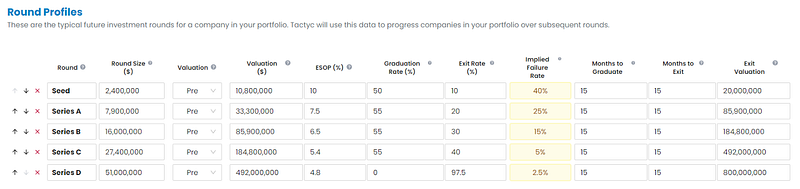
* **They have a clear and counterintuitive way of thinking about reserves.** Instead of stating a single reserve percentage, they derive it from thinking about graduation rate, target ownership, and other factors
\
***All the best-in-class models had a very clear and almost counterintuitive way of thinking about reserves.***
\
A regular portfolio construction model, plugs in a number for reserves, say 45%. But that actually hides away a lot of complexity. The best-in-class models were much more granular in their assumptions. Instead of setting a reserve number up front, the reserve number would be the output of things like their expected graduation rate and target ownership to be held for the next three funding rounds. So they were building on much more basic assumptions.
* **They were all *****very***** focused on getting the portfolio size right and having that as True North.** And in doing so, they were building on actual data with power law dynamics held as a strong underlying assumption.
\
***A lot of these great models that we saw built by these 80 funds were all built with actual market data in mind, which is incredibly important.***
For instance, when investing in a specific region like Western Europe, it's crucial to consider valuation data that aligns with the sector, whether that's FinTech or Crypto.
> If I'm investing in Western Europe, then I want to use round size valuations from Western Europe and from my sector specifically. You want to be very specific at that part of your market research.
It's also valuable to examine other funds' strategies and reserve approaches, although data availability may vary.
**So what’s the ideal portfolio size?** In reality, success in early-stage investments follows the power law. \
\
***Therefore, as a pre-seed investor managing a portfolio of 15 companies, it would require exceptional diligence to mitigate the risks associated with such a diverse portfolio**.*
You must have the greatest diligence in the world to be able to de-risk some of those portfolios because that's a very hard thing to do.
**Certain sectors like biotech may offer unique opportunities for investors with specific expertise. But for general, sector-agnostic investors without a distinct edge, aiming for a minimum of 30 deals per stage in the pre-seed phase seems advisable**.
***
### Solving for pre-final close investing
When raising funds, the reality is that the target amount may not always be fully achieved. **In dealing with this,** **there are two approaches that can be taken.**
**The first approach is to assume the full amount will be raised and deploy checks based on the original strategy.** However, if the full amount is not secured, there may be a shortfall, resulting in fewer deals and opportunities.
**The second approach is to be more conservative.** **This involves adjusting check sizes initially and progressively working towards the target.** This approach is often preferred in the current market environment, and it can be easily explained to Limited Partners later on.
It's important to be prepared for the scenario where the second close is not achieved. To accomplish this, maintaining a live forecast of the fund is crucial. Using a constantly updated model is essential, as a completely new model would mix actual deals with projected ones, leading to confusion.
You need a constantly live model... maintaining a live forecast of your fund is really helpful. To do that in a spreadsheet is difficult.
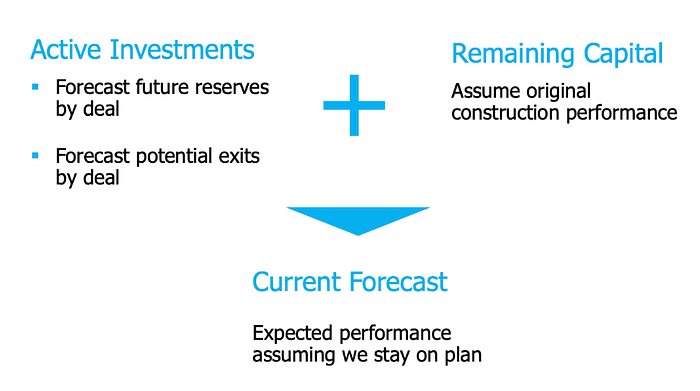
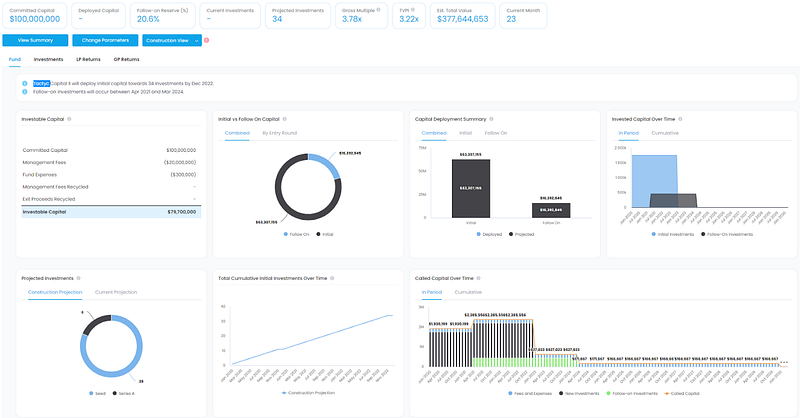
**In Tactyc, for example, a $70 million fund with $10 million deployed would be modeled separately.** The performance of the deployed 10 million would be projected based on factors like graduation rates and risk rates. The remaining 60 million would be assumed to perform according to the original construction strategy, estimating the number of deals it would create. **By combining the modelled 10 million with the forecast for the remaining 60 million, a new construction plan can be established.**
#### So what about reserve allocation during this time?
First, as said earlier, solving for the number of deals is crucial. Secondly, it can be wise to work on the understanding that follow-on investments can be done through different vehicles like SPVs or opportunity funds, providing flexibility if necessary. This can be a quite favorable way of approaching it, as reserving capital upfront is challenging when you've only done a few deals and the actual deployment of that reserved capital may not happen for another two years. Instead, it might be considered more practical to invest in new companies as quickly as possible while keeping an eye on future needs.
Anubhav tells us that he has often seen fund managers over-reserving upfront creating an overly conservative model. In Tactyc **this is addressed by calculating pro rata for the next round while factoring in the graduation rate**.
Some of the companies might never graduate, so you might never get a chance to put your reserves behind them. So doing this, you get a better measure of how much you might wanna park away for the future.
For example, if the graduation rate from a Seed round to a Series A is 70%, risk-weighting the reserves would mean reserving only 70% of the pro rata needed. By risk-weighting the reserves based on graduation rates, you get a better understanding of the capital needed.
***
### Tactyc - a coach as much as a piece of software
We started this article out by saying that VCs shouldn’t be spending all their time modeling. So we asked Anubhav what kind of assistance a user of Tactyc can expect. Let’s see what he says.
> As a founder, a significant portion of my time, around 40%, is spent with clients. Some of it involves educating them and demonstrating how they should be using certain practices. It's important to note that these are not ideas pulled out of thin air but actual best practices we have observed, adding credibility to our approach.
>
> During the onboarding process, a significant amount of time is dedicated to education. Initially, we conduct a comprehensive two-hour onboarding session with all of our clients, where we demonstrate the functionalities of the system. Additionally, in the initial stages, we closely guide our clients to ensure proper setup.
>
> It's important to note that Tactic is designed to work when the entire team is actively involved, from the investment associate to the GP. Therefore, we prioritize training and ensure that everyone is equipped to use the platform effectively.
>
> **We invest a lot of time in education and have extensive documentation on guiding principles**. Apart from Tactyc, we also guide our VCs on how to think about quantitative techniques and the benefits of having a forecast. It's not just about having a model; it's about using it to make informed decisions moving forward. This is a key aspect we emphasize to our clients.
>
> **Let me provide a couple of real-time examples that we've learned from our clients and transformed into features when applicable:**
>
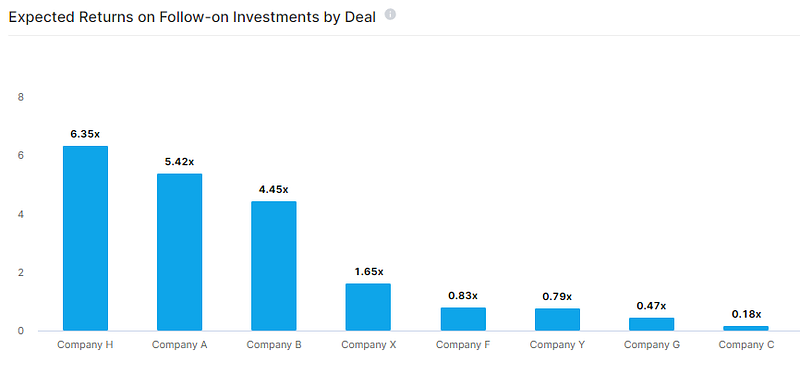
> When it's time to deploy reserve capital after completing 10 deals, the question arises: which company should one invest in? Our clients approach this as an opportunity cost analysis, focusing on multiples. They forecast the growth potential of each company's next unit of currency invested and rank them accordingly. To help in this, **we’ve developed an optimization function that helps allocate funds to companies with the highest multiples, considering actual and forecasted performance.**
>
> Another example is the desire of many clients to convert their RVPI (Residual Value to Paid-In capital) to DPI (Distributed to Paid-In capital). They often hold positions for a couple of years before considering selling 50% of their stake to realize distributions. However, selling at the fair market value might not be ideal as it could dilute the fund's internal rate of return (IRR) if a larger exit opportunity exists in the future. **We offer an analysis where clients can determine the valuation at which selling 50% would maintain the same IRR as the current projection, avoiding a loss in returns.** These analyses can be complex, requiring solvers to find optimal valuations. In Tactic, we've automated a minimum partial sales evaluation calculation that suggests the appropriate sale price for each deal, preserving the fund's IRR.
>
> These are the types of analyses we learn from our clients and strive to share back with them to foster education and understanding.
***
### **Anubhav’s shout-out**
Anubhav acknowledges [**MaC Venture Capital**](https://link.sbstck.com/redirect/acd960c1-1a64-40f9-a288-77384e9df987?j=eyJ1IjoiMXI2aWl5In0.pWNC5J1SeOjGT6Sb4DuyBCmHNoVwMkb39Artb1RhL1I), particularly [**Michael Palank**](https://link.sbstck.com/redirect/9cd11cba-cfc7-4bbd-9477-53c7a579084f?j=eyJ1IjoiMXI2aWl5In0.pWNC5J1SeOjGT6Sb4DuyBCmHNoVwMkb39Artb1RhL1I), as one of their earliest investors who worked closely with them to develop a robust portfolio construction plan and facilitated key connections within networks.
> ***Michael worked with us extensively to develop a solid portfolio construction plan, and connect us with different networks, such as Kauffman Fellows.***
>
> *A product like Tactyc cannot work in isolation - it has to be built in partnership with VCs. Some of our early clients, such as Tusk Venture Partners, Atomico, Motivate, Munich Re are examples of clients we have worked closely to build a product tailed for VCs.*
Anubhav expresses profound gratitude for the pivot that MaC Venture Capital enabled, highlighting Michael's instrumental role in building the portfolio construction dashboard.
> *We pivoted our company, when we realeased a portfolio construction dashboard.*
>
> *The person who built it was Michael Palank, a GP at MaC Venture Capital. And I couldn't be more grateful for that pivot that he gave us. He has been tremendous for connecting us with the right people, broadcasting about us, and speaking aboit portfolio construction.*
>
> *We’ve done* [*podcasts together*](https://link.sbstck.com/redirect/6b5f71c5-38a4-4909-b42b-5aad8a8c9731?j=eyJ1IjoiMXI2aWl5In0.pWNC5J1SeOjGT6Sb4DuyBCmHNoVwMkb39Artb1RhL1I)*,* [*webinars together*](https://link.sbstck.com/redirect/0cbe9c70-37b0-4900-9056-37765063d372?j=eyJ1IjoiMXI2aWl5In0.pWNC5J1SeOjGT6Sb4DuyBCmHNoVwMkb39Artb1RhL1I)*,* [*blog posts together*](https://link.sbstck.com/redirect/fbbb1c10-d066-473d-9484-003b352566a7?j=eyJ1IjoiMXI2aWl5In0.pWNC5J1SeOjGT6Sb4DuyBCmHNoVwMkb39Artb1RhL1I)*. **I am more than fortunate to have an investor like him. Besides capital, I was extremely lucky to have him guide our product.***
***
### Anubhav’s Three Biggest Learnings
#### **1. Never underestimate the power of small teams.**
Anubhav emphasizes the power of small teams, highlighting their **ability to move mountains quicker than larger incumbents**. He urges founders to leverage this advantage by making faster decisions and shipping products rapidly.
> *They can move mountains quicker than large incumbents by 100x. Use that to your advantage. Make faster decisions, and ship products faster, and larger incumbents will still be stuck under process.*
>
> *I personally conduct every demo of Tactic because it allows me to learn, shape our product strategy, and drive our engineering efforts. If I had additional layers of sales reps or engineers, important details could get lost in translation. Being directly involved enables me to move fast and respond quickly to client needs. I can implement feature requests within hours, ensuring we deliver a seamless experience. That's the strength of a small, agile team.*
#### **2. Focus on controllable - and be cognizant of the risk factors outside your control.**
Anubhav's second learning centers around focusing on controllable and being aware of the risk factors outside one's control. As a founder, he stresses the importance of directing energy toward what can be controlled, such as product development and sales processes.
For VCs, Anubhav believes that while they **cannot control the performance of their portfolio companies,** they can control their portfolio construction and investing strategies.
> *As a founder, this means I focus on our product, our customers, and our roadmap. I cannot control things like (a) competition or (b) whether I can successfully close a sale.*
>
> *I can only focus on our product, our sales process, how we demo the product, and how we communicate the product to the client.*
>
> *In the context of the venture, I’ve realized GPs cannot truly control the performance outcome of their portfolio companies, no matter how great their value-add or diligence process - so the only thing they can control is their portfolio construction (how many deals) and investing strategy (check sizes and reserve strategy).*
#### **3. Ignore the naysayers**
Lastly, Anubhav encourages entrepreneurs to **ignore the naysayers and bias toward action**. He acknowledges that startups rarely have a perfect strategy from day one and advises founders to evolve and adapt their strategies over time.
> *When you're first starting a company, it's mostly just about the passion, about wanting to see a product out in the world. Then the rest of the chips, you figure it out as you go. So, if an investor or someone else is asking you in your first year or what's your competitive mode, ignore it right now.*
>
> *Just **continue building.***
Anubhav's insights serve as invaluable guidance for aspiring founders and VCs alike, reminding them to embrace small teams, focus on what can be controlled, and have the courage to defy conventional wisdom.
> *It’s easy to say when a company will fail (small TAM, lack of competitive moat, etc.)*
>
> *These are things that we are taught as MBAs to evaluate - and it’s easy to “play founder”, but bias to action is rare. Rarely do startups have the perfect strategy from Day 1, instead, the strategy evolves and changes over time to address these questions or perceived weaknesses*
***
### The Quickfire Round
#### **Q: What advice would you give your 10 year younger self?**
> *One of the most **impactful books** I've encountered in the last 15 years was:*
>
> ***Malcolm Gladwell's "Outliers."***
>
> *It truly opened my eyes to the immense power of dedicating oneself to a craft for a substantial period of time. Becoming a world-class expert by excelling in something for a decade is a concept that deeply resonated with me.*
>
> *However, there's another book that left an indelible mark on my thinking:*
>
> ***"Talent is Overrated" by Jeff Colvin**.*
>
> *It challenges the notion that talent is the ultimate determinant of success. Instead, Colvin emphasizes the significance of deliberate practice—a relentless pursuit of mastery over an extended duration, surpassing all competition.*
>
> *Personally, I realized that my path diverged from the conventional wisdom of focusing on one discipline for an extended period. Instead, I ventured into multiple domains, striving to excel in each. As an engineer, I delved into investment banking, explored the realms of venture capital, and even embraced the challenges of sales. Although I never achieved world-class status in any one area, this multidisciplinary approach allowed me to **connect the dots and foster creativity.***
>
> *Nevertheless, if I were to revisit my journey from a decade ago, I would advise myself to keep pushing boundaries, exploring new horizons, and pursuing excellence in various disciplines. By doing so, I believe **remarkable opportunities and unforeseen creative avenues can emerge**, shaping a truly exceptional path forward*
#### **Q: What are your top tips for emerging VCs that are fundraising across Europe?**
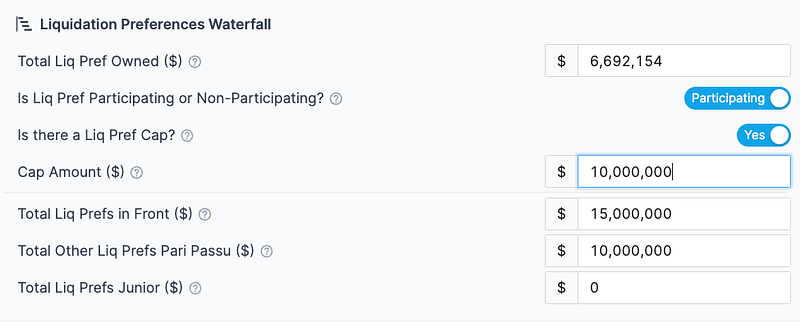
> **1. Don’t over engineer the waterfall structure right from the start.**
>
> *Go with the standard waterfall, the tried and tested two in 20 model for your initial portfolio construction. It's more than sufficient. If necessary, consider including an anchor investor if you're concerned about securing a standard waterfall.*
>
> ***Focus your energy on the portfolio construction** side of things. Clearly define how you will communicate to LPs what your projected power law curve looks like. LPs often inquire about this, wondering which charts are crucial among the plethora of options available.*
>
> *We have a best practices guideline on this, but one chart that should always be shared is **your projected power law curve.** Explain the expected number of failed deals, the range of returns between one and three times the investment, and the underlying graduation rates and exit rates.*
>
> ***Be*** ***transparent** about what this curve entails.*
>
> **2. Understand the capabilities and limitations of your fund admin.**
>
> *Sometimes, there is confusion about whether a fund administrator can fulfill the role of Tactyc. **Fund administrators excel at reporting and accounting**, crucial operational tasks.*
>
> *However, they do not cover forecasting, planning, reserve allocation, portfolio construction, and strategic elements that you'll need to address. It's essential to recognize that you still **require a specialized function** for these crucial aspects, whether it's Tactyc, an Excel spreadsheet, or even the back of a napkin.*
>
> *The important thing is that you **address responsibilities effectively.***
>
> **3. Have a unique and compelling thesis.**
>
> *The third piece of advice I've repeated numerous times is particularly relevant **for pre-seed investors** aiming for a portfolio size of 20 companies or less. In such cases, it's crucial to have **a unique edge or a compelling thesis** within the biotech space, clearly communicated to differentiate yourself.*
>
> *Deviating from standard patterns requires a well-articulated and distinct value proposition.*
>
> **4. Reserve allocation is an opportunity cost analysis.**
>
> *When you reach the stage of deploying capital, remember that reserve allocation is an opportunity cost analysis. You need an objective measure to **determine where the next dollar will be most effectively utilized**. Whether you use a multiple-factor approach or perform internal rate of return calculations, establish a framework to guide your decisions.*
>
> *One common pitfall for GPs is **allowing reserves to become an emotional decision.** Avoid falling into subjective biases based on personal preferences or relationships with founders. Maintain objectivity throughout the reserve allocation process*
#### **Q: What's the most counterintuitive thing you've learned since you've been in VC?**
> *I've learned some counterintuitive lessons along my journey as a founder, and one of them pertains to smaller funds. Surprisingly, **smaller funds often come with more complicated waterfalls**.*
>
> *We've encountered cases where there are multiple anchor investors and various complexities, even for funds as small as 2 or 3 million. Sometimes, even Tactyc struggles to find solutions because these models have deviated so far from the standard structure. I understand that these complications arise because many of these funds have evolved from angel investing, bringing along the baggage accumulated in that realm. It's a challenging problem for us to constantly address and find resolutions for.*
>
> *Another lesson I've embraced as a founder might not be extremely counterintuitive, but it's a valuable insight—**avoid overhiring**.*
>
> *Sometimes, there's pressure to rapidly expand the team, with suggestions to increase the company's size tenfold. However, I've realized that rushing the hiring process can actually hinder progress and dilute our product velocity and focus. Scaling too fast at the wrong time can be detrimental.*
>
> *While I believe we will reach **a point where scaling becomes necessary**, I want to be deliberate and mindful about how we approach and execute the hiring process*
#### Published July 2023
# VC Portfolio Construction Deep Dive - Venture Unlocked with Samir Kaji
Samir Kaji talks portfolio construction trends and best practices with CEO Anubhav Srivastava of Tactyc. Hear why Anubhav thinks a small portfolio is a big mistake for sub-$50M funds.
{% embed url="" %}
December 2022
{% endembed %}
# Using Your Venture Fund Forecast to Manage Investments
Tactyc Founder, Anubhav, and Taylor Davidson of Foresight discuss how to use the forecast you created for fundraising to actively manage your investing activity. March 2023
How should you use your forecast after you've closed on your funding? Join us for a discussion on how to use the forecast you created for fundraising to actively manage your investing activity.\
\
Anubhav is the founder of [Tactyc](https://tactyc.io/), a web-based forecasting and planning platform for VCs, and Taylor is the founder of [Foresight](https://foresight.is/), a creator of tools for VCs and angels to forecast and manage their investment performance. Together, they have worked with thousands of fund managers globally to develop quantitative data-driven processes and workflows for VCs to improve decision-making.
{% embed url="" %}
Using Your Venture Fund Forecast to Manage Investments - March 2023
{% endembed %}
# The Evolving Venture Stack - Going VC Podcast
Tactyc Founder, Anubhav, and Mike Palank of MaC Venture Capital discuss how to be a data-driven manager and how the VC tech stack is ripe for disruption. March 2022
{% embed url="" %}
March 2022
{% endembed %}
**Anubhav’s Book Recommendation:** Moonwalking with Einstein: The Art and Science of Remembering Everything by Joshua Foer
**Mike’s Book Recommendation:** The Case for Space: How the Revolution in Spaceflight Opens Up a Future of Limitless Possibility by Robert Zubrin
**Episode Chapters:**
1. Introduction - 0:00
2. Mike and Anubhav’s Career Origin Stories - 1:12
3. Venture Portfolio Construction - 10:53
4. The Evolving Venture Stack - 33:21
5. Celebrity Investors - 38:21
6. From Hollywood to Sand Hill Road - 48:53
7. 2022 and Closing Thoughts - 53:36
# VC Portfolio Construction and Scenario Planning - Confluence.VC Podcast
A good portfolio construction strategy is an evergreen asset you can keep using to manage investment decisions going forward.
{% embed url="" %}
**Key Takeaways:**
* **Funds that are shutting down right now are going to miss out on some of the best opportunities.** Valuations are down, founders still need capital, and investors that wait on the sidelines are going to miss the upside. Scared money don’t make money.
* **Especially at the pre-seed, revenue shouldn’t be prioritized highly.** Product-market fit and having early indicators of traction matter more than immediate revenue.
* **Portfolio construction is a process. You usually have to lay this out in the fundraise.**
* **A good portfolio construction strategy is an evergreen asset you can keep using to manage investment decisions going forward.** The better you lay this out, the better you can stick to your strategy over the lifecycle of the fund.
* **Your primary goal as a GP is not to create spreadsheets.** It’s to get into deals and raise capital from LPs.
* **Most up-and-coming venture services providers are collaborative and are building out products with a focus on integrations.** Most of the traditional venture services providers are exclusive and want to build a one-stop shop for VCs. It’s easier to see this on the inside, but it holds true.
* **Australia is one of the fastest-growing venture capital markets in the world.** According to Anubhav, they have some of the best internal processes he has seen.
* **Startups need the most help around distribution.** If you want to actually be helpful to your portfolio companies, help them get the word out.
# Top Six Workflows of Data-Driven Venture Managers
The “data-driven” venture fund manager is a term that has gained popularity in recent years. But what does it really mean to be “data-driven” when it comes to portfolio management and planning?
The “data-driven” venture fund manager is a term that has gained popularity in recent years. The rise of AI algorithms, data science, and access to larger datasets have increased the quantitative rigor at traditional venture funds. But what does it really mean to be “data-driven” when it comes to portfolio management and planning?
At [Tactyc](http://tactyc.io), we work with hundreds of data-driven managers globally in helping them with portfolio construction, reserve planning, and portfolio management functions. In our work, we have consistently seen the same common patterns and workflows in our best-performing managers.
Interestingly, we’ve come to the conclusion that being “data-driven” doesn’t necessarily mean the most sophisticated algorithms, custom-built software, or complicated Monte Carlo simulations. Instead, the most data-driven investors mostly work with simple quantitative methods - but follow them in a disciplined manner across their entire portfolio, repeatedly and consistently.
In this post, we’ll summarize the most common patterns and workflows that we see successful data-driven managers employ.
## 1. Building and maintaining a current fund forecast
This is the core workflow of data-driven funds from which many other critical workflows stem.
Most managers build a [portfolio construction model](https://blog.tactyc.io/emerging-manager-operational-road-map-venture-fund-portfolio-construction-models) when raising capital, but very few actually maintain a forward-looking model of their fund after deploying capital. In fact, most portfolio constructions never get opened after the fund is launched. A current forecast is a live forward-looking view of fund performance that takes into account actual portfolio companies.
The fund’s current forecast is built by combining the *expected performance of actual investments and their reserves*, plus assumes *construction performance on undeployed capital*.
\
Once the portfolio construction model is built, the next step is to create forward-looking projections on actual investments. In fact, most data-driven managers we work with also create upside and downside scenarios that are probability-weighted for each deal - and these scenarios can then be rolled up to fund-level upside and downside scenarios. The best fund managers maintain this “current forecast” by constantly updating it for new investments, changing market conditions and trends, and individual portfolio company exit assumptions based on trajectory.
So, why doesn’t every fund do this? Well, given the number of variables, managing these probabilistic models in spreadsheets is very complicated and requires dedicated resources.
However, by ignoring this workflow, managers are effectively cutting off an entire set of valuable analyses (see 2-5 below) that provide rich insights to inform decision-making and improve the likelihood of fund outperformance.
*See more detail on* [*building and managing a VC fund forecast model*](https://medium.com/wharton-fintech/optimizing-vc-fund-performance-with-effective-forecasting-and-planning-1ada078af23e) *in an article with Wharton Fintech.*
## 2. Tracking pacing, market conditions, current and projected TVPI, DPI, and IRR to identify any necessary course corrections
Once the manager starts building and maintaining a current forecast for the fund, they can answer the following questions:
**Pacing:** Are we on track in capital deployed? On number of portfolio companies in total and by stage?
**Changing Market Conditions:** Are valuations and round sizes meaningfully different than when we launched our fund and built our original construction plan? If so, how should our allocations or check sizes change in response to the market?
\
**Investment Terms and Reserves:** Are our actual investment terms meaningfully different from our original assumptions? Are we getting our target ownership in each company? If not, what can we change going forward?
\
These questions are typically asked every 6 months or each quarter in deep internal reviews and allow the investment team to course-correct should actual performance start to meaningfully deviate from projected returns.
The benefit of having a flexible current forecast model is that the manager can input new assumptions for strategies to apply on undeployed capital and immediately see the impact on returns. This allows the manager to understand what they need to execute to get back on track.
## 3. Running Scenario Analysis on Active Investments
Over the life of your fund, your view of each portfolio company’s potential will continue to evolve and become more refined as they demonstrate product-market fit (or not), growth (or not), and a likelihood of exit. New competitors, changes in TAM, management team changes - these can all heavily influence exit outcomes.
Most data-driven managers we work with create the following scenarios for each deal:
* Base Case
* 1x Case
* Write-Off Case
* Moderate upside
* IPO or Home-run case
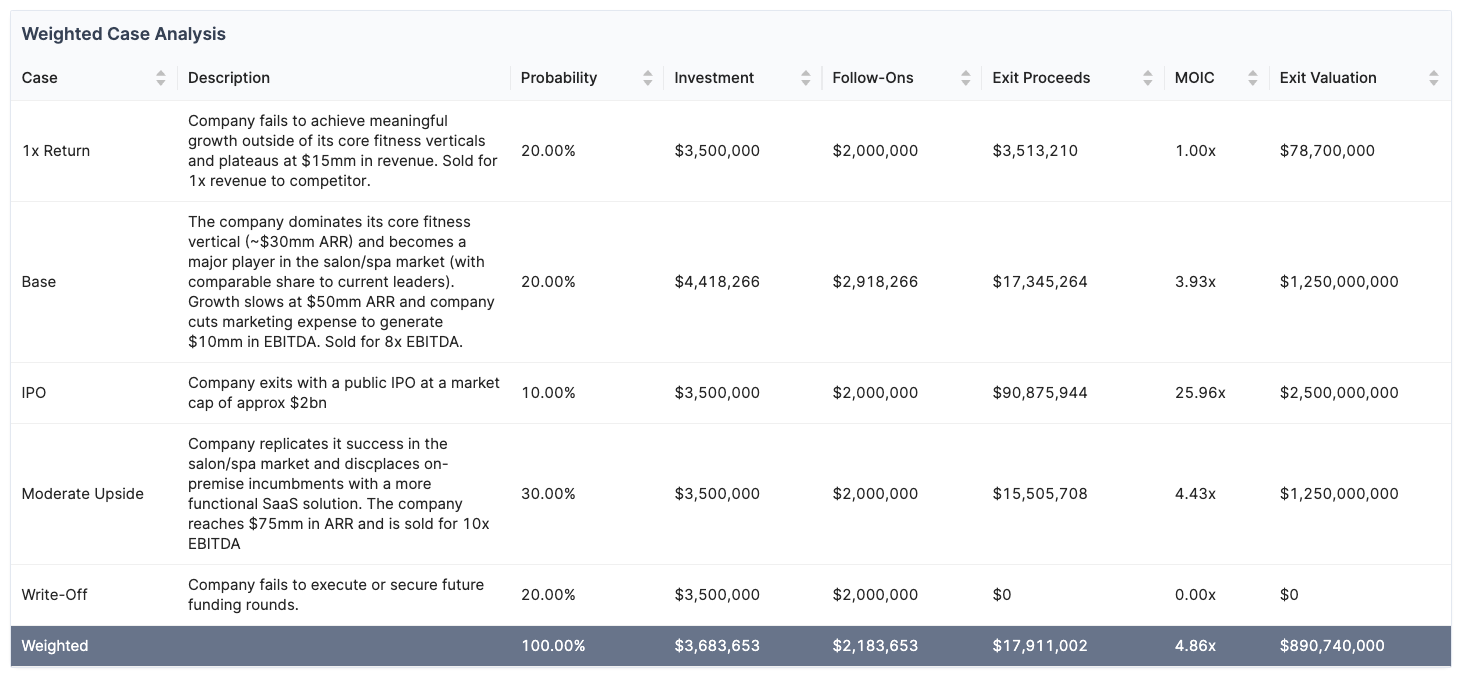
Each of these cases is then assigned probabilities and each case might have a different set of reserve assumptions as well.
A “weighted average” performance is then computed that summarizes the expected MOIC and expected reserves for each deal.
\
These probabilities are evaluated each quarter as part of an internal review - and changed depending on the dynamics of the company and its market.
The benefit of this approach is that it forces the manager to monitor and even quantify risk on each deal and as a response dial up or down their reserves depending on these risk levels.
## 4. Optimizing reserves based on objective metrics
Reserve allocation decisions can often be driven by subjective criteria such as the relationship with the founder and the need to “back your winners”. While there are certainly merits to follow-on from a signaling perspective - a truly data-driven approach requires viewing reserve allocation from an opportunity cost analysis. Is the next $1 best spent on this company, another company, or a new initial check?
To evaluate this, managers need to calculate a Follow-On MOIC (i.e., what is the expected return on the next $1 into each company). If a manager has built risk-weighted scenarios (see #3 above), this analysis becomes fairly straightforward.
In Tactyc, we compute the expansion in share price between a follow-on round and potential exits to come up with the Follow-on MOIC and then each portfolio company is ranked based on this Follow-On MOIC.
\
The Follow-on MOIC enables managers to compare portfolio companies in different markets, stages, and risk levels on an “apples-to-apples” basis.
The reason this works is that the manager is now taking into account all quantitative and qualitative factors, such as growth, TAM, management team, and competition, for each deal when building the deal-level forecast. The Follow-On MOIC implicitly quantifies the outcome of these factors.
When viewed with this objective lens, a manager might even be surprised by conclusions that may seem counterintuitive at first. They might see a “beloved” company rank low or a “smaller” investment appearing high on this list - and these are precisely the types of situations that this workflow is intended to uncover.
## 5. Converting RVPI to DPI opportunistically
LPs want to invest in funds that are thoughtful and responsible stewards of their capital. This goes beyond your investment strategy and extends into thinking about how and when you distribute funds back to your LPs.
One way to do this is to evaluate opportunities to sell partial stakes in investments in order to realize gains (and cash) that may not only create early DPI for your investors but also have a positive impact on your fund returns. There is a point at which receiving some cash today instead of waiting years for a greater total amount of cash actually increases your IRR.
Most data-driven managers we work with ask this question - what is the minimum valuation we should sell (part of our stake in) this company today in the secondary market, for our IRR not to be affected? And if the answer is less than (or close to) the current valuation of the company, then that creates a very actionable opportunity for the fund to actively realize DPI today.
In Tactyc, we automatically calculate the minimum sale valuation today for each active investment.
A drawback to this strategy is that there may be a loss in TVPI, so the manager must believe that 1) future market outlook will deteriorate even further and want to lock in gains today and either distribute or re-invest the realized proceeds into other sectors or 2) they have held the investment long enough or an exit is far enough off to warrant locking in some initial gains even if the company is expected to continue to outperform.
*See more detail on the underlying math of* [*optimizing for partial sales*](https://blog.tactyc.io/optimizing-partial-sales)*.*
## 6. Tracking KPIs for actionable insights
Lastly, most funds track company performance KPIs through their information rights. These are typically revenue figures, cash balances, burn rates, cash runways, etc. However, how the manager acts upon this data can be critical in not only monitoring existing investments but can also inform future investment decisions.
For e.g., some data-driven managers take the revenue collected for portfolio companies and combine them with the valuation data to compute revenue multiples on their entire portfolio. This can then inform portfolio-level or sector-level revenue multiples - and how that is trending over time.
This analysis can also be further parsed out into revenue multiples for individual sectors (SaaS vs. Commerce for e.g.) to understand if the fund revenue multiple is largely in line with the broader sector. And finally, by evaluating revenue multiples and their trajectory, the fund can also be better informed on whether valuations for deals in the pipeline are in line or meaningfully different from their current portfolio companies.
Finally, by tracking KPIs over time, the manager can use the operating performance to tie back to the upside and downside scenarios for each deal, or the reserves allocated to specific companies. If a company is continuously over-performing relative to plan, the manager could increase the upside probability, or start to allocate more reserves anticipating a successful future funding environment for the company.
## Closing Thoughts
These quantitative workflows are accessible to every fund manager, established or emerging, and can be done in spreadsheets or software such as Tactyc. The key is to follow these workflows in a disciplined and consistent manner and work with a live current forecast of your fund at all points in time. In our experience, building and maintaining these models in spreadsheets is resource intensive and not a trivial exercise - which is why we built Tactyc, so every manager can be empowered to deploy these workflows quickly and efficiently.
***See more details on*** [***Tactyc***](https://tactyc.io/) ***and*** [***schedule a demo***](https://tactyc.io/demo)***.***
\-----
Published on August 22, 2023
# Optimizing Partial Sales
How to think about sale valuations in the context of partial sales
## Realizing DPI
In the current market, we are increasingly seeing GPs explore partial sales of their active deals to realize DPI on their funds. This is especially true for deals where the deals have been held for a reasonable holding period, or where the company has had already had meaningful step-ups in valuation since the fund’s initial investment
However the next questions are usually:
* What valuation should we sell at?
* What % of the investment should we sell?
Today, we are releasing a new feature that helps answer both these questions.
## What valuation should we sell at?
While it might be tempting to assume we the fund should sell the position at the prevailing valuation, this approach might now always be adequate as this might end up diluting the fund's IRR.
By realizing liquidity today, the fund is giving up on a higher potential exit later on - and trading off future proceeds for cash today. This is a classic [time value of money](https://online.hbs.edu/blog/post/time-value-of-money) problem. The resulting liquidity from the partial could be put to work into new investments (especially if the fund is recycling exits) to realize even greater returns for the fund.
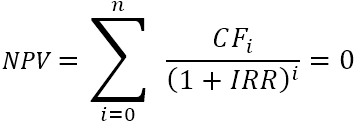
To ensure the partial sale is accretive, the resulting cash flows from a partial sale today should result in at least the *same IRR* as holding the entire investment.
This frequently means the sale valuation might need to be at a slight premium to the current valuation.
This requires a bit of math.
## The underlying math.
Let’s assume the currently projected IRR for a deal (without any partial sales) is **30%** and it's currently forecasted cash flows are as follows:
Next, let’s assume we partially sell 25% of this deal today. Consequently, the resulting exit proceeds in the future will now be reduced by 25% as well. In fact, the new cash flows of the deal without taking into account the partial sale proceeds are as follows (assuming the cash flows for the first 3 periods were investments we have already done):
To compute the minimum partial sale needed to achieve the same 30% IRR, we calculate the NPV of the *New Cash Flows* at a discount rate of 30% (recall IRR is the rate at which NPV is 0).
This resulting NPV would represent the *discounted value* today of the proceeds from the partial sale.
Next, to solve for the company valuation, we first translate the NPV to FV (Future Value) today again at the 30% IRR rate to calculate the *Implied Proceeds from Partial Sale.*
And finally, we imply the Minimum Company Valuation from the Partial Sale Proceeds
## Deal IRR vs. Fund IRR
A naive approach would be to compute the IRR at the deal level (after all we are doing all this in the context of a single deal). Interestingly we have found situations where a partial sale could be accretive at the deal-level, but still dilutive at the fund-level.
The reason is again time value of money. If the fund made an investment later in its investment horizon, there could be deviation between Deal IRR and Fund IRR as the fund-level cash flows would be significantly discounted relative to the deal-level cash flows.
By focusing this analysis on the Fund IRR, we can ensure that the partial sale would truly be accretive to both the Fund IRR and the Deal IRR.
## Tactyc’s Minimum Partial Sale Valuation
Tactyc now automatically computes the **Minimum Partial Sale Valuation** for each active investment with the above logic. Under the **Insights** section of your fund's dashboard, Tactyc shows a table of **Minimum Partial Sale Valuation** i.e the lowest price the fund could sell a partial position in the deal for the resulting cash flows to still be accretive to the fund’s IRR.
Tactyc also adds a few more features to add additional details around this strategy.
* GPs can also flex the **% Sold** variable to understand how much MOIC and Gain they are losing by executing a partial sale
* Tactyc automatically show whether the **Minimum Partial Sale Valuation** is already at a discount to the latest valuation of the company
* Finally, Tactyc computes the **Minimum Partial Sale Valuation** for each performance case (an upside scenario projected to return a 20x would have a higher **Minimum Partial Sale Valuation** than a downside scenario projected to return a 2x).
## More to Come
At [Tactyc](https://blog.tactyc.io/), we are fortunate to see up close and learn from the quantitative workflows of some of the best venture fund managers in the world. We prioritized this feature as we noticed some of our current clients were already executing the above workflow in a manual manner with the [Tactyc Scenario Builder](https://docs.tactyc.io/advanced/scenario-builder) - and to make this process easier and simpler, we decided to automate this workflow for them.
A key lesson we have learned from our more than 250 clients worldwide is that a data-driven manager doesn’t necessarily mean access to proprietary data, Monte Carlo simulations, or an AI algorithm (at-least not yet).
> **More often than not data-driven simply means doing the fundamental venture math (on concepts such as dilutions, sales, reserves, multiples etc.) - but all in a repeatable and disciplined workflow that can be applied across the entire portfolio.**
We will continue to push forward features like these, to make these data-driven techniques a part of your fund’s workflow automatically.
# Optimizing VC Fund Performance with Effective Forecasting and Planning
{% embed url="" %}
June 7, 2023
{% endembed %}
*Written in conjuction with* [*Kailee Costello*](https://medium.com/@kaileecostello?source=post_page-----1ada078af23e--------------------------------) *of Wharton Fintech*
Published in [Wharton FinTech](https://medium.com/wharton-fintech?source=post_page-----1ada078af23e--------------------------------)·7 min read
*This article is a collaboration between Wharton FinTech and* [*Tactyc*](http://tactyc.io/)*, a platform that enables GPs to construct and manage venture portfolios. The team at Tactyc share their insights on the best practices for fund modeling and explain why maintaining an active forecast is important for responding to market shifts and deal terms as well as for optimizing follow-on returns.*
Whether you are an emerging or established VC fund manager, fund modeling and performance forecasting is a core workflow. During the fund-raising process, this is known as portfolio construction; GPs build a hypothetical performance forecast that summarizes the fund’s strategy.
Beyond the fund-raise, active fund managers ideally maintain a forward-looking model to track performance and plan future capital deployment. However, this is frequently very hard to do in spreadsheets given the number of investments and variables – therefore, it is often only done at a high level or not at all. This lack of perspective makes data-driven decision-making in quarterly and annual fund reviews extremely difficult.
In a world where data-driven workflows are becoming more common and necessary (to optimize returns and demonstrate thoughtful processes to LPs), how can GPs incorporate fund modeling into their ongoing workflow? In this article, we’ll explore best practices for fund modeling and common missed opportunities.
**It all starts with construction**
The cornerstone of a successful forecasting workflow starts with portfolio construction. Many managers view portfolio construction as a one-off activity purely for the fundraising process. But, portfolio construction should be the quantitative backbone of your fund strategy and, if done correctly, be used to guide your fund performance. The inner workings of portfolio construction deserve its own blog post which the team at Tactyc have covered in past discussions [such as this](https://www.firstrepublic.com/-/media/frb/documents/pdfs/innovators/fund-model-report.pdf) report with First Republic Bank and [this podcast](https://ventureunlocked.substack.com/p/portfolio-construction-trends-and#details) with Samir Kaji of Venture Unlocked. In short, portfolio construction is a single model that summarizes the fund strategy.
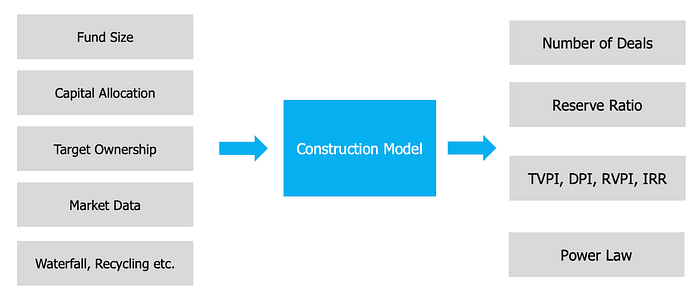
Common “inputs” to this model are:
* **Fund size:** Capital committed to the fund
* **Capital allocation:** Portion of capital allocated to Seed investments vs. Series A, etc.
* **Target ownership:** Desired ownership in each company at entry and in subsequent follow-on rounds
* **Macro and market data:** Expected valuations and round sizes during the investment period, ideally by sector and/or geography
* **Graduation rates:** The likelihood of a company moving to the next funding round vs. the likelihood of failure at each round
The typical model “outputs” are:
* **Number of deals:** Total number of expected deals the fund can do
* **Check sizes:** Average initial entry ticket size
* **Reserve ratios:** Capital earmarked for follow-on investments
* **Performance metrics:** Usually TVPI, MOIC, and IRR for the LP and Carried Interest for the GP
One common mistake is to set a reserve ratio as an input. There are many variables that go into potential reserve requirements (such as: valuations, graduation rates, and target ownership) — all of these factors are overlooked if the reserve ratio is assumed at the start instead of being calculated based on these underlying variables.
It is also worth noting that portfolio construction is useful not just because “LPs ask for it”. It’s the “playbook” for the GP and should ideally be grounded with real-world data. In fact, as we’ll see shortly — a rock-solid portfolio construction plan enables the GP to monitor and course-correct their fund performance in later years.
**Beyond the Fund-Raise**
Once a construction plan is built, funds are raised and capital deployment is underway, it’s easy for a GP to forget about the original construction model. In fact, these models seldom see the light of day beyond the fund-raise. **This is a missed opportunity.**
Once the fund has active investments, it becomes **all the more important** that GPs maintain an active forecast. With actual data layered on top of the construction plan, you can answer important questions such as:
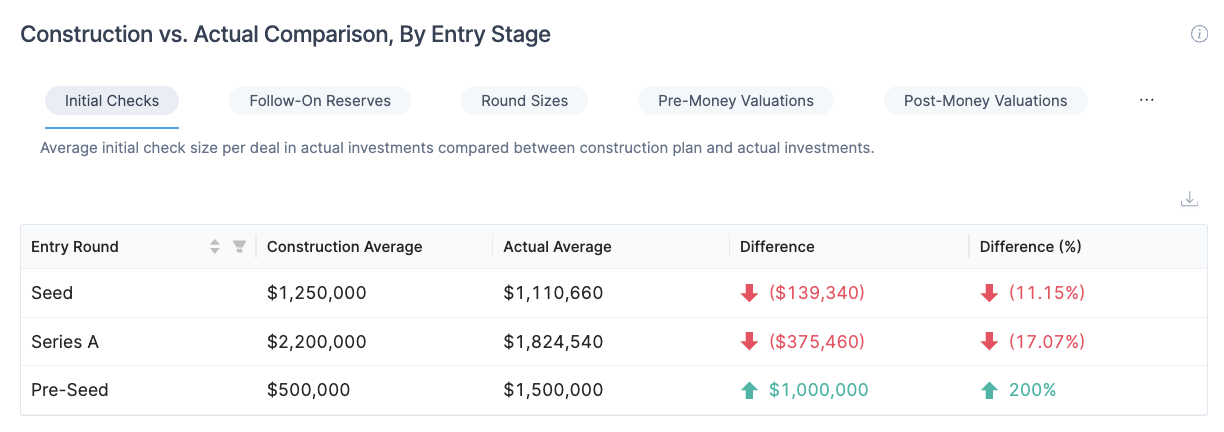
* **Actual vs. planned:** Were our original valuation and check size assumptions too rosy? Has the market moved significantly since we launched?
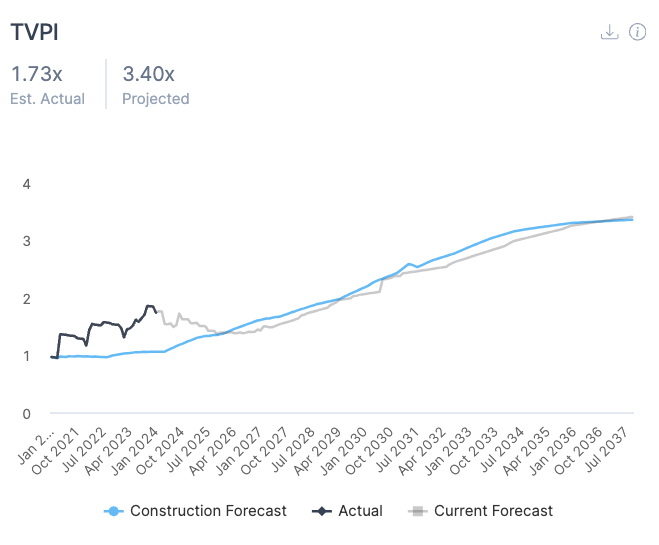
* **Projected returns:** By incorporating actual investment data the model can now start projecting expected returns and give you a line of sight into potential DPI, TVPI, and other return metrics.
* **Course correction:** How can the fund “get back on track”? Should we change our allocation or check size strategy going forward?
The point is to **stay nimble** as a fund. By responding to the latest market shifts and deal terms, GPs can change their “original” assumptions to develop a new thesis based on actual data with insight into how those changes are expected to impact performance.
**How is this done?**
To build a forecast for an active fund, GPs need to:
* **Build deal-level forecasts for individual investments.** This requires delving into each investment, building an underwriting case, and setting future reserves and expected exit scenarios.
* **Assume a performance level for the remaining undeployed capital**. Usually, the undeployed capital is assumed to perform as per the original (or revised) construction plan.
Combining the deal-level forecasts and the construction plan gives the GP a current forecast. This is the new expected performance of the fund that takes into account its actual deals.
**Deal-level forecasting**
Building deal-level forecasts requires forecasting future rounds, future dilutions, and future exit scenarios for each investment.
Many GPs also build multiple probabilistic scenarios for each deal (such as a downside case, IPO case, and a 1x return case) and summarize the results in a *Weighted Case Analysis.*
The result of all of this work is GPs now have expected exit multiples and future reserves for each active investment.
**Adding it all together**
Combining the deal-level forecasts with the undeployed capital plan now enables GPs to analyze:
* **Actual deployment vs. plan:** How have our actual initial checks deviated from our original plan?
* **Pacing:** How many deals have we done to date, and how many can we still do going forward?
* **Performance:** What is our TVPI to date and how does it compare to plan?
**Reserve planning**
Perhaps the most important benefit of forecasting is that it can help GPs optimize follow-on reserves toward their best investments.
Once individual deal forecasts are built, GPs can compare the expected return on the *marginal dollar of investment* in each company*.* This enables GPs to compare each investment on an “apples-to-apples” basis and take opportunity cost into account. If the fund were limited on reserves, it should aggressively follow-on into *the companies with the highest margin return*.
The reason this works is that you are taking all quantitative and qualitative factors, such as TAM, management team, and competition, into account for each deal when building the deal-level forecast. This expected return multiple is risk-weighted by all the above factors — enabling the fund to compare one company with another in an objective manner.
**Putting this into practice**
The above workflow is not trivial to implement with spreadsheets and frequently requires multiple resources to maintain these forecasts effectively.
That’s why Anubhav Srivastava founded [Tactyc](http://tactyc.io/) — a platform that enables GPs to construct and manage venture portfolios without being burdened by spreadsheet workflows. Tactyc works with 200+ venture funds globally today by empowering every manager with a data-driven approach to fund management.
A GP can **build a robust portfolio construction plan in Tactyc in minutes**. The platform provides the ability to flex all of the above-mentioned construction parameters in an interactive model in order to optimize the fund’s strategy and then easily share the plan with potential LPs. [See an example model here.](https://tactyc.io/published/venturemanager)
* For deal-level forecasting, Tactyc offers the ability to bulk import your existing investments and then forecast by round for each portfolio company, including automatically reserving your pro-rata or defining a specific investment size.
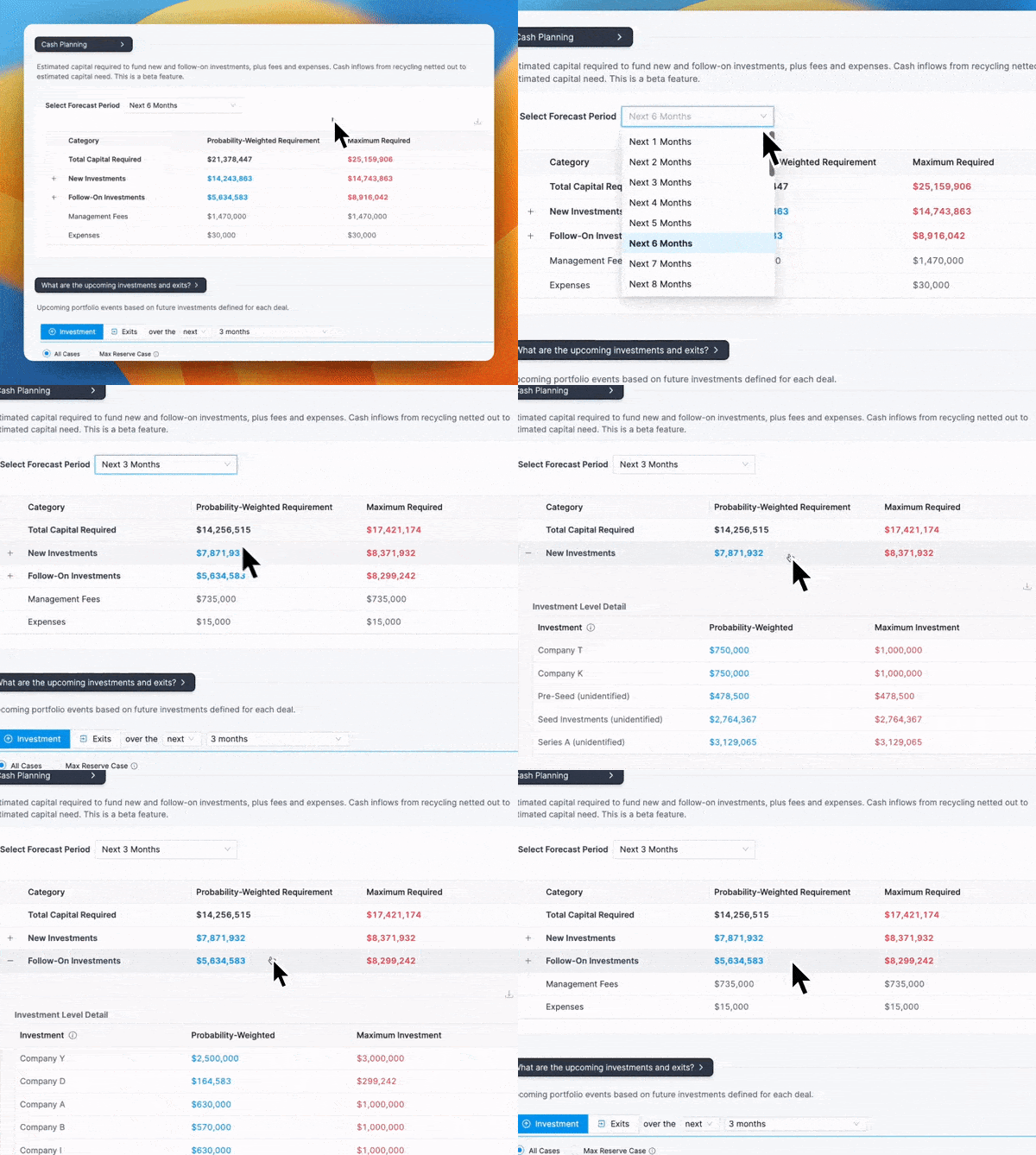
* Tactyc then combines your deal-level forecasting with your construction strategy for undeployed capital to calculate projected fund performance. This helps aggregate your future capital needs and evaluate fund performance vs. plan.
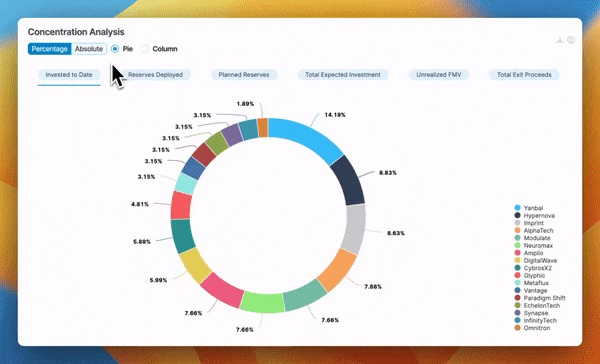
* Lastly, Tactyc provides robust portfolio insights and reporting. GPs can easily compare the companies with the highest marginal return for reserve planning, can analyze how their funds are deployed across sectors/geographies, and can identify their best-performing co-investors
—
**About the authors**
Tactyc is a platform that enables GPs to construct and manage venture portfolios without being burdened by spreadsheet workflows. If you’d like to learn more about Tactyc, visit [tactyc.io](https://tactyc.io/) or [schedule a demo here](http://calendly.com/tactyc/demo).
[Kailee Costello ](https://www.linkedin.com/in/kaileecostello/)is an MBA Candidate at The Wharton School, where she is part of the Wharton FinTech Podcast team. She’s most passionate about how FinTech is breaking down barriers to make financial products and services more accessible — particularly in the personal finance space. Don’t hesitate to reach out with questions, comments, feedback, and opportunities at .
# Leveling Up on Return the Fund Analysis
**What is Return the Fund?**
*Return the Fund* is a common analysis managers undertake when evaluating venture deals. This involves calculating a *Return the Fund* metric i.e. the aggregate valuation a company needs to achieve in order to pay back the entire fund. A “Fund Returner” is a single deal that achieves this threshold — and while rare, deals like these are critical given the Power Law nature in VC.
Tactyc automatically calculates and presents *Return the Fund* in different contexts to answer various questions for the manager.
**For Portfolio Construction**
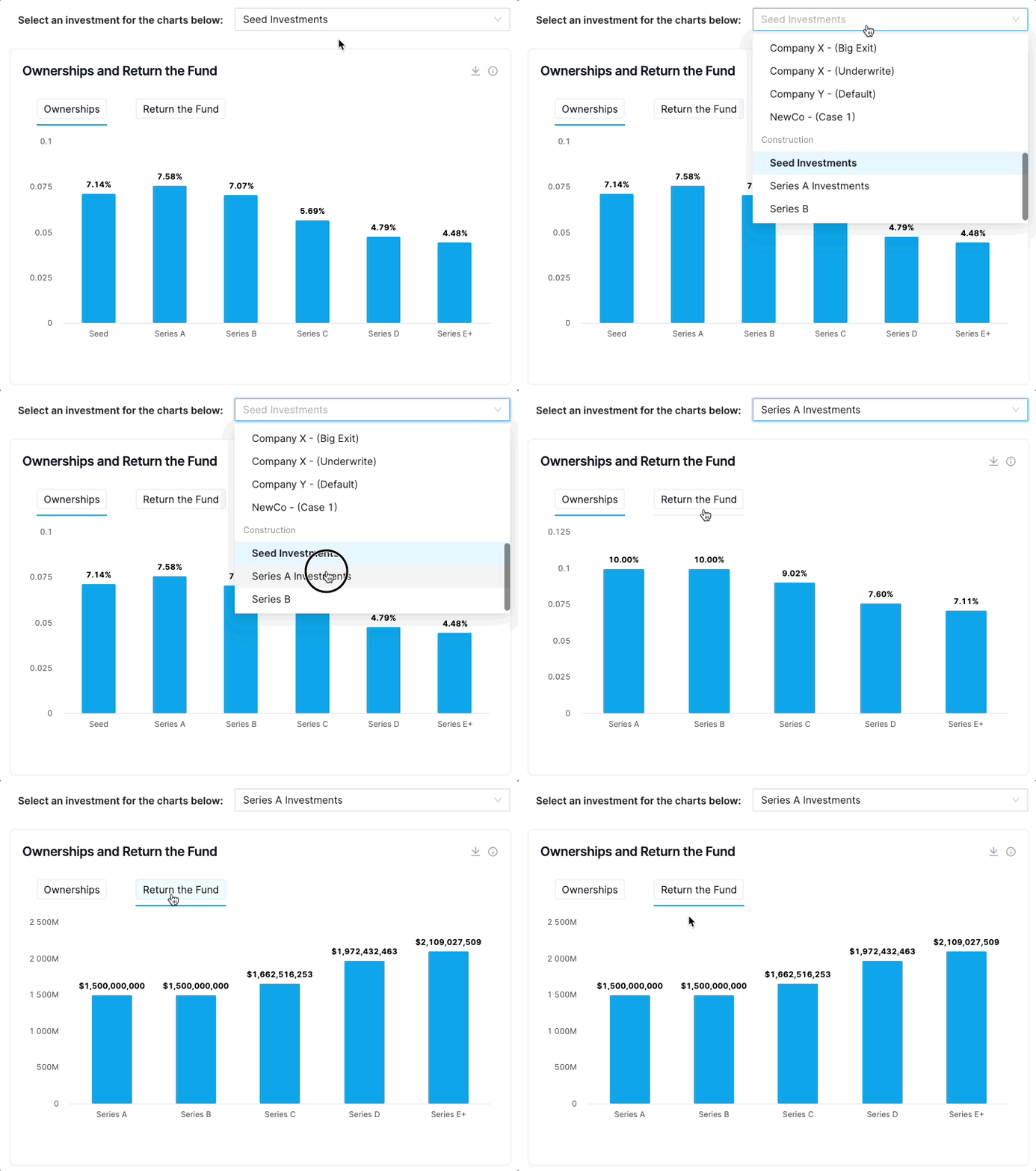
When constructing a fund, Tactyc shows the *Return the Fund* for each allocation and how that changes over subsequent rounds (shown in the *Rounds* section of your fund’s dashboard).
As the fund’s ownership dilutes over subsequent rounds, *Return the Fund* increases — and this can be helpful in setting future reserves to keep this metric in check.
**Beyond Construction**\
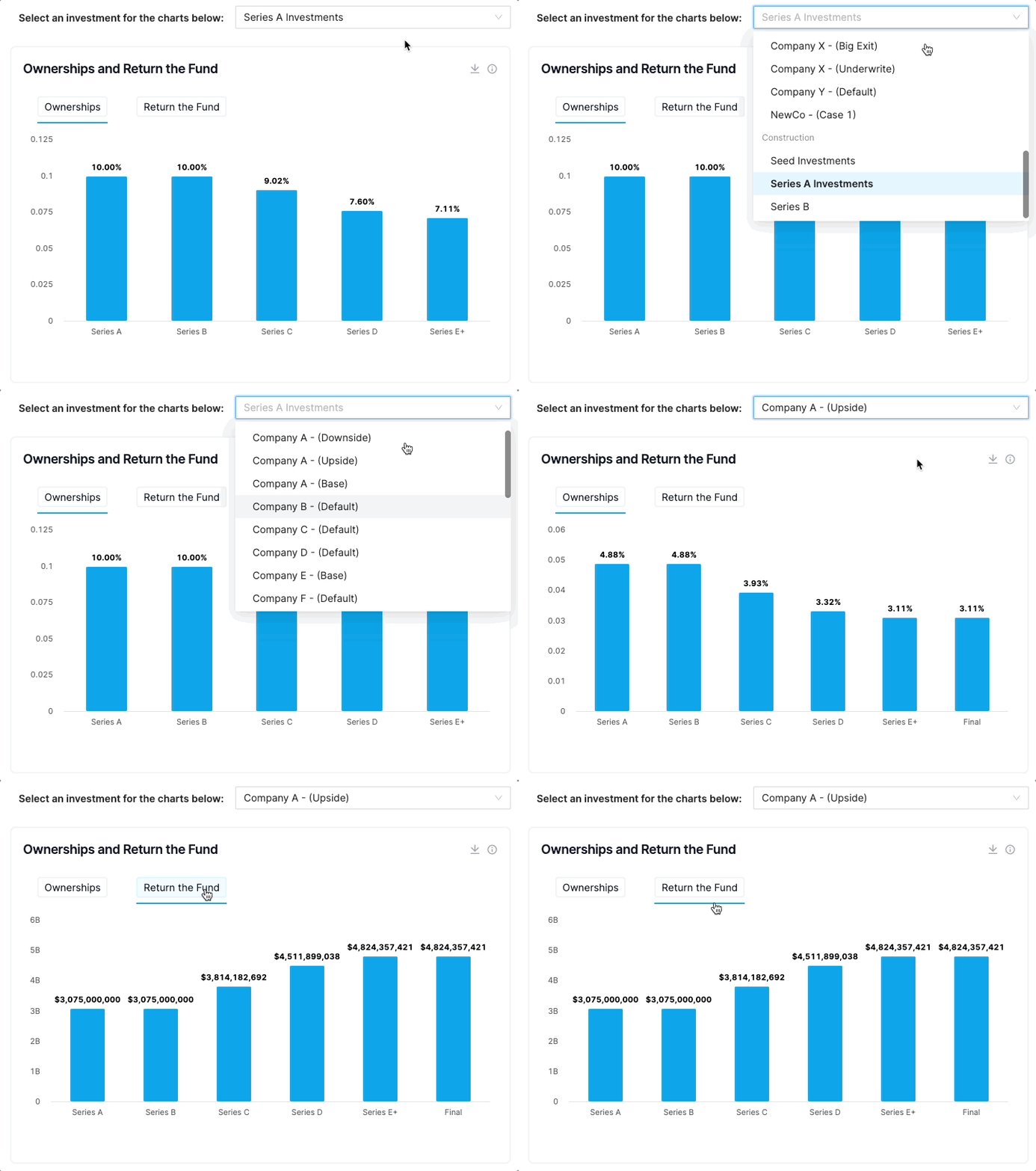
Similarly, for active portfolio companies, Tactyc automatically calculates the *Return the Fund* at each forecasted round. Simply select a specific investment’s performance case to view the *Return the Fund* profile.
**For Determining Reserves**
When setting reserves for a future round, Tactyc automatically shows how *Return the Fund* changes at different reserve levels. As reserves increase, *Return the Fund* decreases and thus a manager can use this as a guide to optimize their reserve for a particular deal.
By [Tactyc](https://medium.com/@tactyc) on [November 25, 2022](https://medium.com/p/d6731c4e26f2).
# Leveling up on MOIC Analysis
Moving beyond the simple MOIC - a look into seven different types of MOIC calculations and they can be used in fund analysis.
#### **Leveling up on MOIC Analysis**
The Multiple of Invested Capital (MOIC) is arguably the most common performance indicator in VC. Along with IRR, every LP report has a series of “marks” that show the Current MOIC on a deal.
One of the reasons MOIC is so common is that it’s simple to calculate…
…and simple to understand. Anything above 1.0x is a profitable deal and anything below is a loss.
However, as you’ll see below, MOICs are more than just a reporting metric. In fact, they can be a very useful *planning* metric, especially for reserve deployment. But for that, we have to first take a look at the different types of MOIC calculations that are possible (spoiler alert: there are upto 7 different MOICs).
**Moving beyond the simple MOIC**
At [Tactyc](http://tactyc.io), we’ve seen that most data-driven managers work with multiple MOICs — and each MOIC answers a different question for the manager or helps them develop a more nuanced understanding of deal performance.
For e.g. the simple MOIC can be “extended” to include future return expectations (which are usually built based on management projections and underwriting thesis). This enables us to take MOIC from a reporting into a planning perspective.
MOICs can be further refined by separating the performance of initial investments from the follow-on investments, thereby letting us analyze reserve performance standalone.
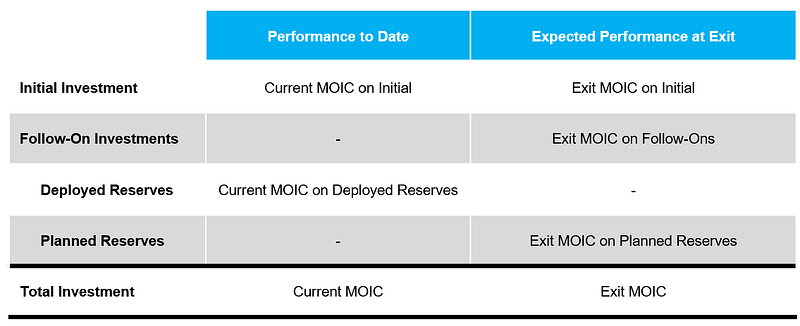
It might be helpful to think of MOICs along these lines:
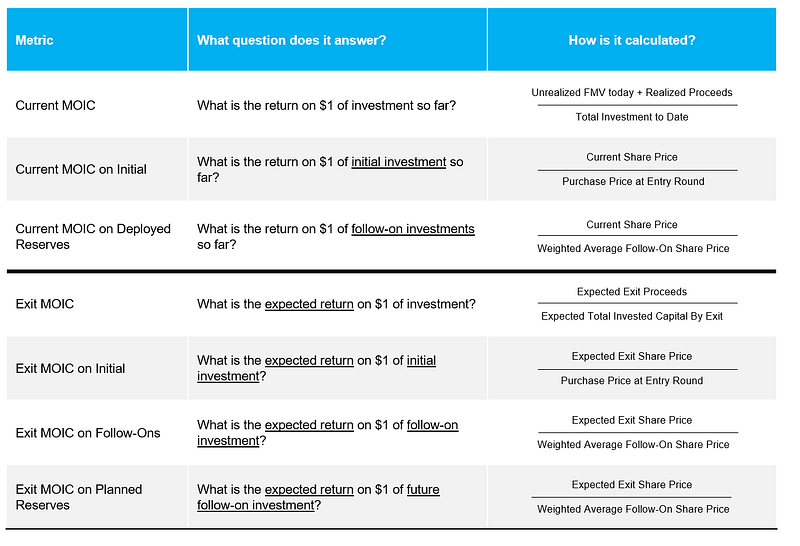
And here is a comparison of the question each MOIC answers along with the calculation methodology
**A special mention**
The **Exit MOIC on Planned Reserves** deserves special mention as it is a very useful metric in optimizing reserves. By summarizing the future follow-on performance it enables us to compare one company’s reserves with another.
When optimizing follow-on reserves, comparing this metric can guide future follow-on deployments. In [Tactyc](http://tactyc.io), we automatically calculate and rank all of your portfolio companies based on this metric.
**Not always quite as simple**
Despite seeming simple, some of the MOIC calculations can get quite complex. For example:
* If there are multiple follow-on investments, the Current MOIC on Deployed Reserves needs to be calculated on a *weighted average share price of follow-ons*.
* Realized proceeds from partial sales need to be incorporated in every single MOIC calculation above
* If a SAFE or Convertible Note is involved, the MOIC on initial investment needs to account for conversion price
At Tactyc, we see only a small percentage of funds have the analytical workflows that enable calculation, tracking and monitoring of these metrics — as calculating them in spreadsheets is not always trivial. However, we’ve also seen that the managers that do follow these workflows are able to better quantify their reserve planning process to LPs and are also consistently outperforming the benchmarks.
That’s why we created Tactyc! So every manager can be empowered with these data-driven analyses without having to manually build them.
**About Tactyc**
[Tactyc](https://streaklinks.com/BQMr3BtnpyKyv2cIhg01Yy0g/http%3A%2F%2Ftactyc.io%2F?email=anubhav%40tactyc.io) is the first performance forecasting and scenario platform for VCs and is used by more than 160 funds globally. Our software enables VCs to easily manage and forecast venture portfolios and replaces much of the traditional complicated spreadsheet workflows. If you’d like to explore Tactyc for your fund, please visit [tactyc.io](https://blog.tactyc.io/www.tactyc.io) or [schedule a demo](http://tactyc.io/demo) here.
By [Tactyc](https://medium.com/@tactyc) in conjunction with Kauffman Fellows on [November 25, 2022](https://medium.com/p/71026cf536ea).
# Next Level Portfolio Construction w/ Software - Why It Matters
The benefit of a flexible construction model is that it can now be updated with real data to offer insights into how the fund is performing - we have crystallized these workflows into Tactyc.
{% embed url="" %}
Guest post written by [**Anubhav Srivastava**](https://www.linkedin.com/in/anubhav-srivastava-3555442/)**, Tactyc Founder,** on TheFundCFO Newsletter**. Oct 2022**
{% endembed %}
**Why is portfolio construction important? Not just because LP’s will ask for it!**
Many managers believe portfolio construction to be a one-off activity. Construction models are primarily used in fundraising, when LPs review your assumptions and ask questions around reserves and check sizes.
Post-launch, the original construction model is frequently “thrown away”. Models are viewed as theoretical exercises - with limited practical use for active fund management.
This is a mistake, in our opinion.
At [Tactyc](https://tactyc.io/) we have seen that successful managers build construction models in such a way that they help GP’s guide *actual fund performance.* In this post, we’ll look under the hood to shed light on these best practices for constructing fund models that every manager can employ at their fund.
**Elements of an effective construction model**
At Tactyc we have helped hundreds of emerging and established managers build their construction strategy. We have also reviewed countless spreadsheet-based construction models and found the following common themes among *effective construction models*:
**1. Clear model inputs and outputs**
Many managers fall into the trap of confusing model outputs with model inputs. For example, some managers start off with “we need a follow-on reserve of 40%” or “we expect to invest in 40 companies” and then build a model based on those assumptions.
Instead, great construction models start off with more *basic* assumptions (i.e. what is the *graduation rate* you expect in your portfolio, what are your *target entry ownerships*) and use them to *build up* to reserve ratios, number of investments and expected portfolio performance.
Determine the smallest number of variables that are fixed and let the model tell you bigger picture metrics such as follow-on reserves, number of investments etc.
In Tactyc, we guide managers through a checklist of questions such as expected graduation rates, check sizes or target ownerships in each round - and calculate the reserve ratio and expected number of deals as outputs instead of inputs.
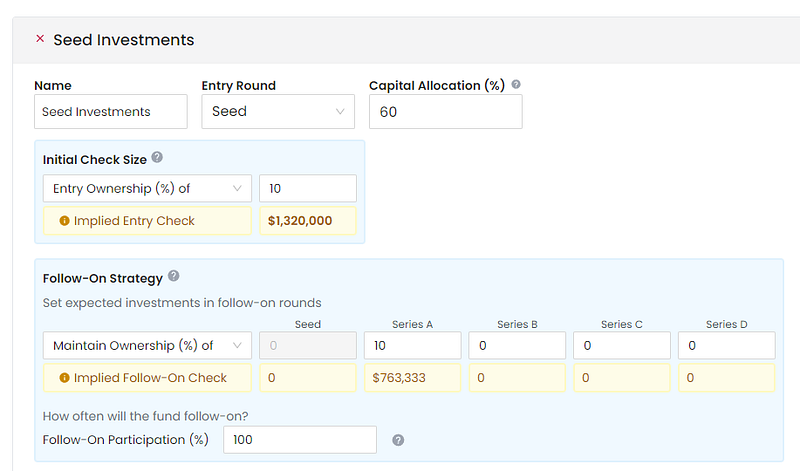
For example, the follow-on amount at the fund level is calculated based on:
* Number of deals graduating *(Graduation Percentage)* x How often the fund will follow-on *(Follow-On Participation %)*
**2. Flexible**
Another common approach we have seen is to model a fixed portfolio of X investments with some failures and success rates as a representative portfolio.
The problem? This is a static model that represents *one scenario* and is not flexible enough to stress-test with other scenarios. If you need to change exit assumptions, follow-on reserves or target ownerships that might result in a completely different portfolio strategy - and it might require a complete rebuild of your original static portfolio.
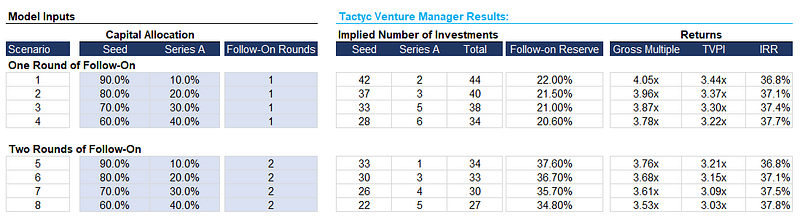
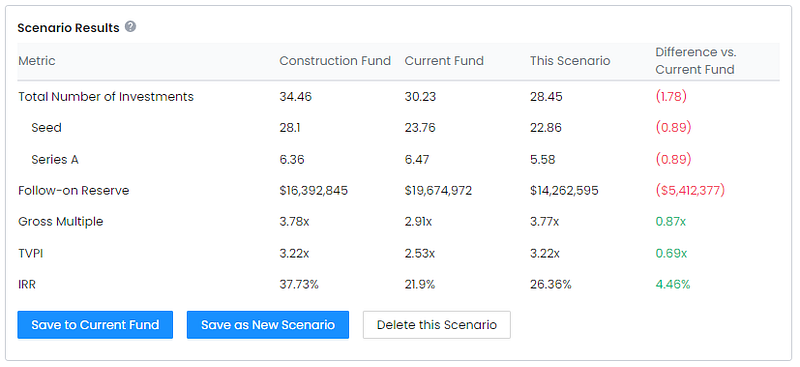
In Tactyc, managers can build multiple fund *scenarios* (e.g. a higher reserve or lower reserve scenario) and compare them with each other side by side to evaluate which might be a better fit.
**3. Real-world data**
Finally, your model assumptions should be based on real-world data. If you’re investing in FinTech, to get a 10% ownership at entry in a Seed stage requires you to collect and find average valuations in the sector - and your expected check sizes should be based on this market data.
Similarly if you are expecting a 40% reserve ratio, you should collect graduation rates for your sector (how many companies on average graduate from Seed to Series A for example) - as that heavily influences the potential follow-ons your fund has access to.
This also enables you to update market assumptions around round sizes, valuations and graduation rates to quickly generate a new performance forecast for comparison if the market has moved significantly in the future.
In Tactyc, we ask every manager to decide on a *sector profile* where they can manage assumptions on round valuations, graduation rates and exit rates. We provide real-world benchmarks by industry to guide them through this process.
**How does this guide actual fund performance?**
The benefit of a flexible construction model is that it can now be updated with *real data* to offer insights on how the fund is performing. For example, if your fund is 30% deployed, you can update the model to include your actual deals - and let your model forecast the remaining 70% to be deployed as per your construction assumptions.
This arms the GP with:
* **Actual vs. Planned:** Were our original valuation and check size assumptions too rosy? Has the market moved significantly since we launched?
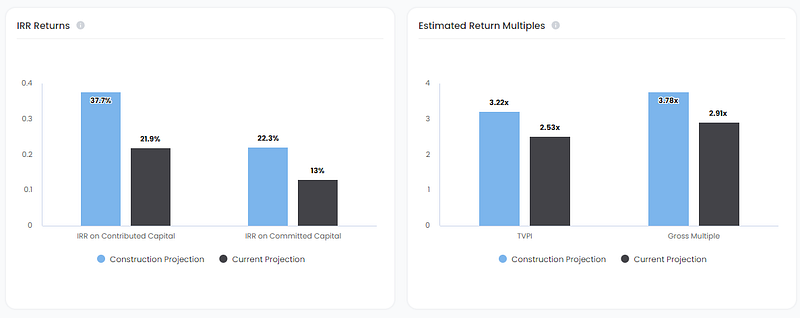
* **Projected Returns:** By incorporating actual investment data the model can now start projecting expected returns and give you a line of sight into potential DPI, TVPI and other return metrics.
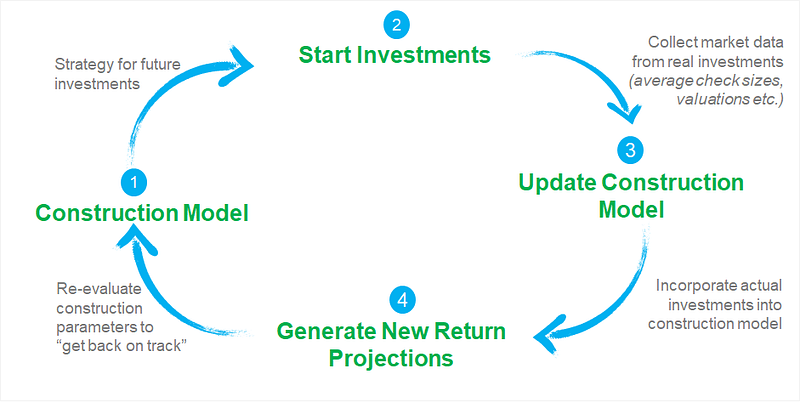
* **Course Correction:** How can the fund “get back on track”? Should we change our allocation or check size strategy going forward? Questions such as these can be answered once you have layered your actual data on top of your construction plan.
This is a powerful feedback loop that many managers use to drive outperformance. By having a constantly “alive” portfolio model that not only projects future returns but offers comparisons with original construction plans, GPs are armed with more data-driven insights on future capital deployment.
**Closing Thoughts**
At Tactyc, we have seen repeatedly that this workflow, while powerful - can be difficult to execute with spreadsheets. Excel workbooks can quickly get out of hand as GPs need to build and maintain multiple scenarios for comparison.
We have crystallized these workflows into Tactyc so any manager can construct, manage and strategize their fund without spending time on mechanically building complicated spreadsheets. Please reach out to if you’d like to learn more or [schedule a demo with us here](http://tactyc.io/demo).
# Emerging Manager Operational Road Map - Venture Fund Portfolio Construction Models
First Republic Bank recently organized a panel of experts to discuss the role and construction of portfolio allocation models, the latest real-world modeling insights, and modeling best practices.
{% embed url="" %}
# Strategies for Optimal Follow-On Investments
We discuss follow-on strategies in detail and the quantitative methods used for follow-on reserve allocation and deployment.
#### Strategies for Optimal Follow-On Investments
Post-launch, a fund manager’s focus shifts from portfolio construction to active portfolio management — and a frequent pain point is follow-on reserve sizing on active deals. Most managers grapple with optimal follow-on reserve for a deal and oftentimes struggle to determine how follow-on reserves should change over time. We’ve surveyed the best practices of hundreds of emerging managers and in this post, we shed light on the quantitative frameworks used to answer both of these questions.
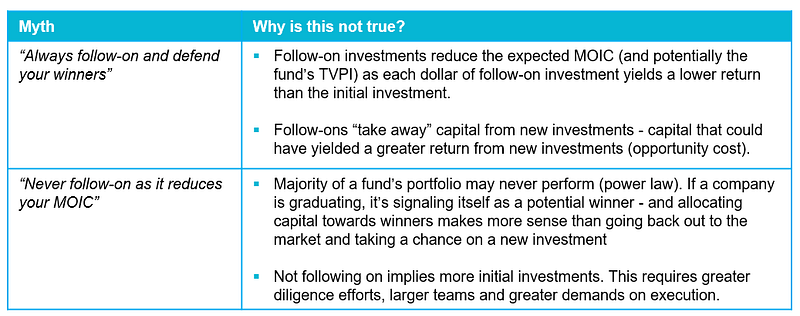
***Before we begin, let’s address a few misconceptions we’ve seen regarding follow-on strategies:***
Most managers take a balanced approach — they’ll follow on in deals where the managers continue to have conviction while passing on a few where the exit expectations have drastically reduced. We’ve noticed that the decision to follow on is frequently *sentiment-driven.* Managers may “fall in love” with a deal, fall prey to the [sunk cost fallacy](https://en.wikipedia.org/wiki/Sunk_cost), or make follow-on investments based on their relationships with founders.
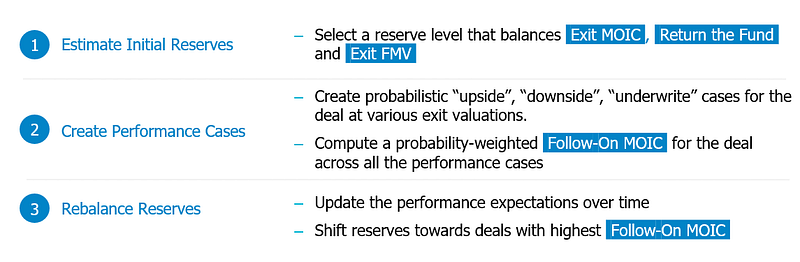
To avoid these pitfalls, we’ve noticed most successful data-driven managers follow a *quantitative workflow* that periodically takes into account a company’s expected performance to size reserves, rebalance reserves, and eventually deploy reserves. This is what the workflow looks like:
Executing the above workflow in action requires a bit of math. This is where [Tactyc Venture Manager](http://vc.tactyc.io/) comes in — a portfolio scenario-planning platform that automatically executes this workflow.
**The Workflow in Action**
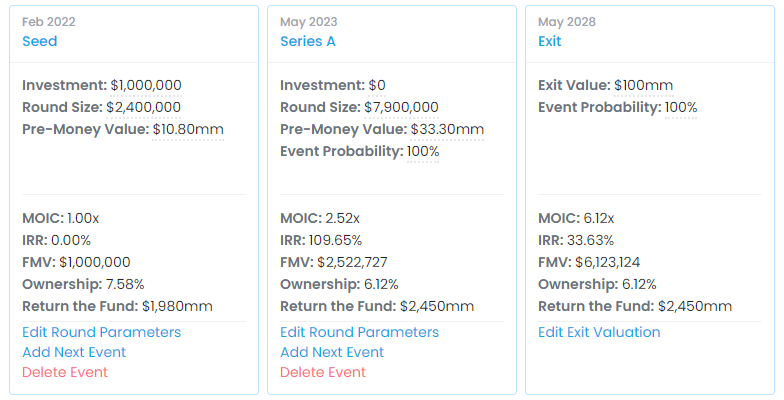
Let’s say we’ve made a $1M seed investment in *Company X* — and our underwrite case expects the company to exit at a $100M valuation. We’ve built the underwrite case in Venture Manager as follows:
*Step 1: Estimate Initial Reserves*
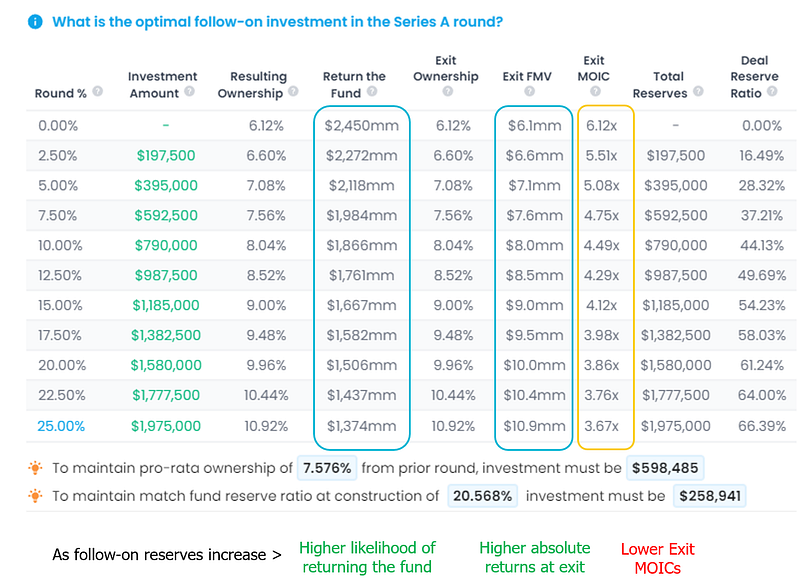
What is the optimal reserve amount for the future Series A round? Venture Manager helps answer this by summarizing impacts to *Exit MOICs, Return the Fund, Exit FMV* at various reserve levels:
Picking the right reserve level here is a balancing act. We don’t want the *Return the Fund* metric to increase beyond reasonable valuations — but also want to reduce depression on *Exit MOIC*. We also want to compare this deal’s reserve ratio with our overall fund reserve ratio to ensure we aren’t significantly over or under-allocating reserves for this investment vs. our overall fund’s reserve ratio.
*Step 2: Building Performance Cases*
Next, we build multiple performance cases for this investment at various exit values (e.g. a “downside” and “upside” case with 20% probability each). Venture Manager automatically summarizes the *Exit MOICs, MOIC on Initial Investment,* and *MOIC on Follow-on Investment* across each case:
Based on the above, Venture Manager’s recommended reserve level is $900K for a future follow-on investment in *Company X*’s Series A round.
It’s worth pointing out the *Follow-On MOIC* metric of 3.98x — this is the key. The *Follow-On MOIC* is the expected return on follow-on investments *only*.
Many fund managers miss calculating this essential metric (as the math can become somewhat cumbersome), but as will become evident shortly, this is a powerful metric to compare expected returns on reserves across deals in the rest of this workflow.
*Step 3: Periodically Rebalance Reserves*
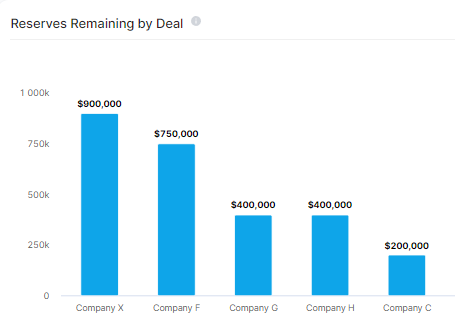
Over time our view on each investment’s potential exit values and probabilities may change as we track the company’s actual performance to projected — this is an opportunity to re-balance deal reserves. Let’s say our current reserve levels are as follows:
And after 6 months, we review *Company X*’s operating performance and compare it to our projection built at the time we made the first investment — and realize that the company is falling short of our expectations.
We decide to revisit our downside case for *Company X* and increase its probability to align exit expectations with actual performance data.
**Our expected Follow-On MOIC has now drastically reduced from the original 3.98x to only 1.65x**. Are there other companies in our portfolio where this follow-on reserve may be better spent? To answer, we take a look at the *Follow-On MOIC* metric across our entire portfolio to compare investments on an apples-to-apples basis.
Company H, A, and B all have higher Follow-on MOICs than *Company X*. We want to maximize reserves in H, A, and B (subject to available pro-rata rights in those companies) and should consider shifting reserves from *Company X* to *Company H, A, or B* instead.
The point here is that by taking expected performance into consideration across deals, we can allocate the greatest reserves to the highest yielding deals — and continuously rebalance as our performance expectations change.
**Closing Thoughts: Data-Driven Workflows = Crucial**
Reserve planning and deployment can become more art than science. This workflow removes emotions and avoids sunk cost fallacies to creep into the decision-making process. [Tactyc Venture Manager](http://vc.tactyc.io/) makes scenario-planning workflows easy and readily available — without having to update or manage complicated spreadsheet models. We’ve crystalized this specific follow-on workflow into our software by computing *Follow-On MOICs* for every deal automatically. We want to empower every emerging manager with these strategies from day one.
**Upcoming Webinar on Follow-On Strategies**
Join us on Thursday, March 24 2022 at 1 pm Eastern for a live webinar on follow-on strategies. We’ll be joined by Michael Palank, Partner at MaC Venture Capital, and Anubhav Srivastava, Founder of Tactyc, to discuss follow-on strategies in detail and the quantitative methods used for follow-on reserve allocation and deployment. [Join us by registering here!](https://us02web.zoom.us/webinar/register/WN_C_NYkHJmTSu01TrfODFNbg)
Tactyc ([tactyc.io](https://blog.tactyc.io/www.tactyc.io)) is a portfolio construction and scenario planning software for venture funds. If you’d are interested in using Tactyc for your portfolio management and planning, [schedule a demo](https://calendly.com/tactyc/demo) to learn more.
{% embed url="" %}
Written by Anubhav Srivastava, Tactyc Founder. March 2022
{% endembed %}
# Secrets of the Data-Driven Fund Manager
How do successful data-driven VCs manage their fund forecasts? They all use a powerful analytical workflow that creates a feedback loop enabling them to constantly course-correct their fund.
#### Secrets of the Data-Driven Fund Manager
**Learning From Successful Managers**
Over the past few months at Tactyc, we have surveyed various data-driven venture managers to see how they create and manage their fund forecast models. Does their success lie in access to proprietary data? Superior quantitative methodologies? Surprisingly, the answer turned out to be simple — they all use a powerful analytical workflow that creates a feedback loop enabling them to constantly course-correct their fund.
In this post, we’ll show you this workflow in action with [Tactyc](http://tactyc.io), a new product that lets any manager deploy these feedback loops in minutes and without the need for complicated spreadsheets. [An example of a fund model is shown here.](https://vc.tactyc.io/published/uIM6t9co-)
**It All Starts With Construction**
Successful managers are very *deliberate* and *precise* with their portfolio construction parameters and spend hundreds of iterations refining them. They don’t hold any preconceived notions on allocations, follow-on reserves, check sizes, and number of investments — instead letting their model answer it for them.
In contrast, we’ve seen many emerging managers build construction models with the end in mind. For example, they may assume a portfolio of X companies and a follow-on reserve of 40% and then back into the fund returns needed to fit these constraints. Such models are rarely flexible enough for the manager to question assumptions they already assume to be true (i.e. portfolio size, follow-on reserves % or capital allocations) and lead to the manager “missing out” on finding alternate optimal structures.
Part of the problem is that building a *flexible* construction model from the ground up in a spreadsheet is not a trivial task given the large number of variables in play, and if done correctly can take weeks to build.
Tactyc Venture Manager lets managers build a state-of-the-art fund model in minutes by simply answering a few questions around your fund structure and round profiles. For example, [we’ve set up a $100mm seed fund](https://vc.tactyc.io/published/uIM6t9co-) that invests primarily in Seed and Series A companies. We’ve defined future round profiles, round sizes, pre-money valuations, ESOP dilutions, and graduation and exit rates. Venture Manager takes all these assumptions to automatically build a *probabilistic* construction model.
**Defined Round Profiles**
**Capital Allocation Example**
In this example above, we’ve:
* allocated 60% of our investable capital to Seed Investments and any follow-ons resulting from those investments (remaining 40% to Series A investments).
* initial investment based on a 10% Entry Ownership (implying a check size of $1.32mm)
* follow-on strategy to participate until Series A with an investment of $763k to maintain 10% ownership
Some funds prefer to specify check sizes instead of tracking to an ownership and there’s no preferred approach. Venture Manager lets you choose either method to determine how long, how often and how much they want to exercise their pro-rata.
The model results are summarized in a visual dashboard below.
**Visual Dashboard of Model Results**
The fund is projected to make 34 investments (28 Seed and 6 Series A), hold a follow-on reserve of 20.6% and projected to return a gross multiple of 3.78x and a TVPI of 3.22x.
**Exploring Alternate Allocation Scenarios**
Next, we’ll flex the allocations and follow-on strategies to see how portfolio sizes and returns change. We have modelled 8 scenarios:
In Scenario 1–4 the fund follow-on for 1 additional round, and in Scenarios 4–10 the fund follow-ons for 2 additional rounds. We’ve also flexed allocations in each scenario. The results show that increasing Series A allocations decrease returns and also decreases our number of investments while increasing follow-on rounds reduces the number of initial investments the fund can make and also reduces our fund returns.
**Exploring Recycling**
Exit recycling is a powerful mechanism to increase investable capital, create alignment between LPs and GPs and increase the number of investments without increasing commitments. The general idea is to recycle proceeds from realized exits and re-invest them into new or follow-on investments. In Venture manager, we’ll set up our fee structure to recycle 25% of our management fees from exit proceeds::
This resulting matrix compares fee recycling on investable capital, number of investments, and fund returns.
With a 100% recycle, our investable capital is almost at parity with the total committed capital (the difference being the fund expenses) — implying the LPs see very little fee leakage on their commitments.
**Putting It All Together**
In a few minutes, we’ve explored the impacts of flexing allocations, follow-on strategies and exit proceeds recycling. The final decision on construction parameters involves qualitative discussions around team size, diligence capabilities, market conditions, hiring plans, etc that determine how many investments the fund could support and the cadence they are comfortable with.
**Updating the Construction Model with Actual Investments**
After the fund is launched, successful managers constantly benchmark their actual fund metrics, not just with the broad indices but also relative to what they had originally constructed *— and then they go on to update their construction model to find a better strategy for future investments.* This creates a powerful feedback loop, where the original construction model is constantly updated with existing investments to develop new projections. By evaluating the spread between actual and construction plans, these managers tweak and adjust their original construction parameters to course-correct on future investment decisions.
In contrast, many first-time managers completely abandon their construction model after launch. The minutiae of updating books for investments and computing multiples and IRRs etc. is frequently classified as “fund administration” and not part of daily or weekly partner discussions. The downside is that the fund is swayed heavily by market conditions and if the market ends up being vastly different than they thought, they aren’t able to quickly find new strategies for future investments.
In Venture Manager, we’ve defined 6 successful investments for the fund.
Next, we can do a market check. Venture Manager shows us how the fund’s average initial check sizes, follow-on reserves and entry pre-money valuations compared to our construction model.
The above metrics show the market has been more expensive than originally modeled — the pre-money valuations are higher, the initial check sizes are greater and a larger amount of reserves have to be allocated per deal. *The result is that despite successful exits on some of these investments, the final projected TVPI for the fund is 2.53x, almost 22% lower than expected construction TVPI of 3.22x.*
**Finding Strategies to Course Correct**
How do we get the fund back to a 3.22x TVPI? The manager can update their original construction parameters with new check sizes and valuations based on their market data — and adjust allocations and follow-on strategies to regain back the loss in return multiple. For example, we ran a new scenario where we decreased the number of investments we’ll follow on into (effectively saying we’ll be more judicious in our follow-ons instead of following onto every single graduation) and increased our Seed allocations vs. Series A. The result is we can “get back on track” to a 3.22x TVPI.
**Closing Thoughts**
There is no “proprietary data” at work here and none of the math presented above is difficult. The key to the data-driven manager is this workflow — a “market-updated” construction model always at hand that can answer future investment strategies.
While all of the above could be done in spreadsheet models that get updated periodically — we found that these probabilistic spreadsheet models are difficult to build from scratch, and even more cumbersome to manage with real investments. Most emerging managers simply revert to a Google Spreadsheet for tracking their investments, but rarely update their construction models to answer future investment questions.
We built Tactyc so every manager can integrate this data-driven process in minutes — and we welcome your feedback on ways to improve it.
— —
Tactyc is available at [tactyc.io](https://blog.tactyc.io/www.tactyc.io). We welcome feedback from the community that can help us improve the platform and to make fund analytics easier and simpler for every emerging manager. If you’d like to onboard your fund’s model into Venture Manager, please [schedule a demo](https://calendly.com/tactyc/demo) here.
{% embed url="" %}
Written with the Kauffman Fellows. November 2021
{% endembed %}
# Follow On in Venture Capital
Follow-on allocation is one of the most important considerations a VC fund manager can make. A more detailed analysis to follow-on strategy can yield more purposeful and better-performing funds.
{% embed url="" %}
Tactyc & MaC Capital, "Follow On in VC" August 2021
{% endembed %}
# Venture Fund Portfolio Construction with Kauffman Fellows
Portfolio construction is the careful calculus of a number of different decisions related to how a fund is run and the impact that each of those inputs has on the other.
{% embed url="" %}
Written By: [Mike Palank (MaC Venture Capital) and Anubhav Srivastava (Tactyc)](https://www.kauffmanfellows.org/journal_posts/venture-fund-portfolio-construction). April 2021
{% endembed %}
# API Endpoint for Investment Cash Flows
We've introduced a new API endpoint to programmatically access the cash flows related to an investment.
We've introduced a new API endpoint to programmatically access the cash flows related to an investment. [Learn more here.](https://tactyc.us10.list-manage.com/track/click?u=cfb475ec1956d4b952006ee92\&id=2405ec34a4\&e=9e1e1a8fc8)
\*\*\*
*Originally published in the Tactyc newsletter on September 26, 2023.*
# Realized IRR Calculation
IRR performance summary now includes a Realized IRR calculation that calculates the IRR from realized cash flows only.
\*\*\*
*Originally published in the Tactyc newsletter on September 26, 2023.*
# FX Impact Analysis
Tactyc can now summarize the impact to fair market values from fluctuations in FX rates for foreign currency investments.
Tactyc can now summarize the impact to fair market values from fluctuations in FX rates for foreign currency investments.
For any portfolio company, where the investment round was in a different currency than the fund's currency, Tactyc can re-calculate the FMV impact at different FX rates.
This analysis is available under the **Cash and FX** section of your fund's dashboard.\
\*\*\*
*Originally published in the Tactyc newsletter on September 26, 2023.*
# Bulk Update Custom Fields
Starting today you can bulk update these custom fields from the Update Qualitative option from your Investments page
A few weeks ago, we introduced [Custom Fields](https://docs.tactyc.io/portfolio-management/using-custom-fields) as a way to track additional information for each portfolio company. Starting today you can bulk update these custom fields from the **Update Qualitative** option from your **Investments** page. Simply download an Excel spreadsheet with your current qualitative data (including Custom Fields), update them offline and import back into Tactyc to update them.
\*\*\*
*Originally published in the Tactyc newsletter on September 11, 2023.*
# Custom Instructions in KPI Requests
You can now customize KPI requests to include additional custom instructions in the KPI request form.
You can customize your email template that goes to portfolio companies as well as add custom instructions. These additional instructions will automatically be added in the header for each KPI request.
\*\*\*
*Originally published in the Tactyc newsletter on September 11, 2023.*
# Introducing Custom Fields
Starting today, you can create **Custom Fields** to track and report on additional data on portfolio companies. These could be color codes ("traffic lights"), texts, tags, numbers or dates and these fields work alongside Tactyc's existing fields such as Deal Tags, Sector, Geography etc. [Learn more here.](https://tactyc.us10.list-manage.com/track/click?u=cfb475ec1956d4b952006ee92\&id=472d39a835\&e=9e1e1a8fc8)\
\
**Step 1: Define Custom Fields and Type.**\
Define up to 10 custom fields for each portfolio.
**Step 2: Set Data for Custom Fields**\
Within each investment, access and set data for the custom fields.
**Step 3: Report by Custom Fields**\
Expose custom fields on the investments table for filtering and sorting. Custom Fields are also available on Tactyc tearsheets.
\*\*\*
*Originally published in the Tactyc newsletter on July 31, 2023.*
# Bulk Import and Configure KPIs
The Tactyc KPI Manager now supports bulk importing new KPIs with an Excel spreadsheet option as well as configuring KPIs in bulk.
## Bulk KPI Importing
To bulk import KPIs, simply download the Excel sheet, add your KPI data and upload it into Tactyc to start using the [Tactyc KPI Manager.](https://tactyc.us10.list-manage.com/track/click?u=cfb475ec1956d4b952006ee92\&id=9bbd5503ee\&e=9e1e1a8fc8)
## Bulk KPI Configuration
Quickly configure KPIs in the KPI Manager with **Bulk KPI Configuration** module. This enables you to quickly change items such as reporting frequency, start dates, data formats and other elements from a single unified view.
\*\*\*
*Originally published in the Tactyc newsletter on July 31 and September 11, 2023.*
# Introducing Budget Creator & Fund Expense Charts
Create a fund budget in one click. The new Budget Creator automatically creates standard expense categories such as Legal, Administration, Taxes etc. based on common expense ratios.
The fund dashboard now also summarizes actual and projected **Fund Expenses** and **Expense Ratios** by line item.
\*\*\*
*Originally published in the Tactyc newsletter on July 9, 2023.*
# Import Company Information from Crunchbase
Auto-populate qualitative data such as company description, sector, founders and geographies for your portfolio companies directly from Crunchbase with a single click.
\
**Automatically import portfolio company data directly from Crunchbase**
\*\*\*
*Originally published in the Tactyc newsletter on July 9, 2023.*
# Introducing Capital Call Line of Credit
A Capital Call Line of Credit is commonly used by fund managers to increase the fund's flexibility to execute deals without having to wait for capital calls.\
\
Starting today, you can create a line of credit on your fund from *Construction Wizard > General,* to evaluate impact on cash flows, performance and expected interest expenses. [Learn more](https://docs.tactyc.io/advanced/capital-call-line-of-credit).
Once the facility has been defined, Tactyc automatically calculates drawdowns, repayments and associated interest expense and summarizes the results on the fund's dashboard.
**Line of Credit Balances and Usage Efficiency**
**Interest Expense and Unused Fees**
**Drawdowns and Repayments**
| The **Capital Call Line of Credit** is available on our Enterprise Plans only. [Contact us](mailto:support@tactyc.io) if you are on a Solo or Construction Plan to explore this feature. |
| ---------------------------------------------------------------------------------------------------------------------------------------------------------------------------------------- |
\*\*\*
*Originally published in the Tactyc newsletter on June 26, 2023.*
# Partial Sale Optimization Analysis
We are increasingly seeing GPs explore partial sales of their active deals to convert RVPI to DPI. This is especially relevant where the deals have been held for a reasonable holding period and where the company has experienced meaningful step-ups in valuation since the fund’s initial investment.\
\
When a fund is exploring this strategy the common questions are:
* What valuation should we sell at?
* What % of the investment should we sell?
Today, we are releasing a new feature that helps answer both these questions.\
\
**Minimum Partial Sale Valuation**\
Tactyc now automatically computes the **Minimum Partial Sale Valuation** for each active investment. This is the lowest price the fund could sell a partial position for the resulting cash flows to *still be accretive to the fund’s IRR.* This analysis is available under the **Insights** section of your fund's dashboard.
* You can flex the **% Sold** variable to understand how much MOIC and Gain is traded off in a partial sale
* Whether the **Minimum Partial Sale Valuation** is already at a discount to the latest valuation of the company
* How the **Minimum Partial Sale Valuation** changes by performance case (for e.g., an upside scenario projected to return a 20x would need a higher partial sale valuation than a downside scenario projected to return a 2x).
**The Underlying Math**\
At Tactyc, we are fortunate to see up close and learn from the quantitative workflows of some of the best fund managers in the world. Frequently, when we see common patterns across multiple clients - we crystallize those manual analyses into automated features.\
\
This particular analysis was one that many of our clients were already utilizing. If you are curious about the underlying math powering this analysis, check out [our recent blog post](https://blog.tactyc.io/optimizing-partial-sales) on how we automated this analysis.
\*\*\*
*Originally published in the Tactyc newsletter on June 19, 2023.*
# Introducing Round Valuation Analysis
Starting today, Tactyc automatically calculates and summarizes valuation multiples (such as Revenue multiple) for your entire portfolio.
These multiples can be further evaluated by geography, sectors, tags and changes over subsequent rounds.
Under **KPI Manager > Valuation Analysis**:
* Select a valuation multiple from the [list of KPIs collected](https://docs.tactyc.io/portfolio-management/kpi-manager) (such as ARR)
* Select optional filters such as entry round, geography, sectors or tags
The summarized results will show the following:\
\
**1. Average Valuation Multiple (Portfolio-Level)**\
Mean or median valuation multiple over subsequent rounds across the entire portfolio.\
\
**2. Valuation Multiple Trends By Deal**\
Valuation multiple over subsequent rounds visualized for each portfolio company.
\
\
**3. Valuation Multiple Detail By Deal**\
Valuation multiple for each deal downloadable into an Excel report.\
\*\*\*
*Originally published in the Tactyc newsletter on June 5, 2023.*
# Portfolio Concentration Analysis
Portfolio concentration analysis is a common report that summarizes the contribution of each portfolio company to overall fund metrics.
Starting today, Tactyc automatically summarizes and visualizes portfolio concentration across 6 different dimensions:
* Total Invested to Date
* Reserves Deployed
* Planned Reserves
* Total Expected Investment
* Unrealized FMV
* Total Exit Proceeds
\*\*\*
*Originally published in the Tactyc newsletter on May 22, 2023.*
# Cashless Contributions for GP Commitments
Tactyc now supports cashless contributions for GP commits (or management fee waivers) natively. Simply setup the Cashless Contribution % in the General section of the Construction Wizard.
\*\*\*
*Originally published in the Tactyc newsletter on May 15, 2023.*
# Beta Release: API Access and Zapier Integration for Tactyc
| 86751d527c3a42919ff53168ecdd0192 |
| -------------------------------- |
|
API Endpoints We have released API endpoints so you can programmatically add investments into your Tactyc fund or retrieve fund performance reports. Learn more.
Zapier Integration Along with the API access, we have also released a Zapier action to enable integrations with 5,000+ apps on Zapier including AirTable, Affinity, Google Sheets etc. Learn more.
Beta Disclaimer API and Zapier access are Beta features with limited access and subject to change. Please contact us at in order to obtain an API Key to use these features.
|
| ----------------------------------------------------------------------------------------------------------------------------------------------------------------------------------------------------------------------------------------------------------------------------------- |
\*\*\*
*Originally published in the Tactyc newsletter on May 1, 2023.*
# Quickly Run Fund Scenarios in Tactyc
We've made it easier to run fund performance scenarios by enabling you to "activate" certain performance case for your investments in Tactyc's Scenario Builder.
Use Case: Build a fund "upside" or "downside" scenario quickly by activating the "upside" or "downside" cases for each investment. [Learn more.](https://docs.tactyc.io/advanced/scenario-builder#running-fund-scenarios-based-on-individual-investment-scenarios)
\*\*\*
*Originally published in the Tactyc newsletter on May 1, 2023.*
# Request KPI Projects from Portfolio Companies in Tactyc
Starting today, you can customize a KPI Request to ask for projections data, not just actuals.
While the primary goal of Tactyc's KPI Manager is to request **actual KPI data** from portfolio companies, we recognize there may be instances where you want to request projections data too. Now you can do that in Tactyc.
\*\*\*
*Originally published in the Tactyc newsletter on April 24, 2023.*
# Import SAFEs into Cap Table Calculator in Tactyc
The Cap Table module now supports importing outstanding SAFEs in bulk with an Excel template. Useful if a company has a large number of outstanding SAFEs so you don't have to enter them manually.
\*\*\*
*Originally published in the Tactyc newsletter on April 17, 2023.*
# Add Exit Scenarios to Portco Tearsheets in Tactyc
Deal tearsheets can now be further customized with exit scenarios from performance cases. Useful for internal portfolio reviews to report on expected exit scenarios by investment.
\*\*\*
*Originally published in the Tactyc newsletter on April 17, 2023.*
# More Market Intelligence: Comparable Companies in Tactyc
We've expanded the Market Intelligence module to provide funding history by company. Simply search by company name to pull funding history & use the data to build funding scenarios for your deal.
Click on **MarketIntel** from within an investment to access this feature.
**Note:** Searching for funding rounds by company is an *Enterprise Plan* feature only. *Solo Plans* can search for round sizes and valuations by sectors or geographies only. If you're on a Solo plan and would like access to this feature, please [contact us.](mailto:anubhav@tactyc.io)
\*\*\*
*Originally published in the Tactyc newsletter on April 10, 2023.*
# Introducing Market Intelligence in Tactyc
Starting today, Tactyc has partnered with Crunchbase to provide you with Market Intelligence on sectors and geographies to build custom sector profiles.
| 1812fffe49d147f79805aec739ae2bb0 |
| --------------------------------------------------------------------------------------------------------------------------------------------------------------------------------------------------------------------------------------------------------------------------------------------------------------------------------------- |
|
From Construction Wizard > Sector Profiles, you can now search market data by country or sector to analyze round sizes or valuations by percentile.
|
|
From Construction Wizard > Sector Profiles, you can now search market data by country or sector to analyze round sizes or valuations by percentile.
We will be further expanding on the Market Intelligence module with features to search for comparable companies and funding rounds ("comps") for each investment.
You'll be able to leverage this comps data within each investment to:
Build future rounds based on comps
Build upside / downside cases based on comps
Build likely exit scenarios based on comps
Watch this space for the next release.
|
|
Coming Soon: Company and Transaction Comps
We will be further expanding on the Market Intelligence module with features to search for comparable companies and funding rounds ("comps") for each investment.
You'll be able to leverage this comps data within each investment to:
Build future rounds based on comps
Build upside / downside cases based on comps
Build likely exit scenarios based on comps
Watch this space for the next release.
|
| -------------------------------------------------------------------------------------------------------------------------------------------------------------------------------------------------------------------------------------------------------------------------------------------------------------------------------------------------------------------------------------------------------------------------------------------------------------------------------------------------------------------------------------- |
\*\*\*
*Originally published in the Tactyc newsletter on April 3, 2023.*
# KPI Manager Customization in Tactyc
We have added new features that increase customization of KPI requests generated with the Tactyc KPI Manager.
**Logo Branding**\
KPI Requests are now automatically branded with your fund's logo, along with other UI upgrades.\
\
[](https://tactyc.io/)\
\
**Control Metrics Visibility**\
You can now hide certain KPI metrics so they are not included in external KPI requests. This enables you to build different KPI requests for the same company and change which metrics you ask for (for e.g. a quarterly vs. annual request).\
\
[](https://tactyc.io/)
\*\*\*
*Originally published in the Tactyc newsletter on March 13, 2023.*
# Cryptocurrencies Support in Tactyc
You can now define investment rounds in any of the major crypto-currencies and Tactyc automatically performs exchange rate conversions.
\
Supported crypto-currencies are: **Bitcoin, Binanecoin, Dogecoin, Ethereum, Litecoin and Ripple**\
\
[](https://tactyc.io/)
\*\*\*
*Originally published in the Tactyc newsletter on March 6, 2023.*
# Tracking Share Level Data in Tactyc
When defining an investment round, Tactyc now enables you to enter share-level data for each round with far greater flexibility than before.
**Here is how it works...**
Share-Level Data in Tactyc’s Rounds
While each round always had an *Enter Share Data* field previously, users would find this option frequently disabled:
* If the round was not priced (SAFE or Note)
* If any prior rounds were also not entered in “share mode”
This was problematic — as SAFEs and Notes are the most common entry rounds, any future rounds would automatically be restricted from entering share level data.
Starting today, we have removed this restriction so **any priced round** can be defined with share-level data.
#### **But First.**
> *Tactyc is first and foremost **a forecasting and scenario-planning platform** for VCs. It is not meant to be a replacement for a fund administration platform or an accounting system of record (at least not yet).*
> *It’s meant to enable GPs to operate their funds more efficiently and in a data-driven manner that increases the likelihood of outperformance.*
Tactyc’s primary use-cases are:
1. **Portfolio Construction, Performance Forecasting, Reserve Planning (aka fund modeling)**
Tactyc is **a** **front-office platform** that enables GPs and investment teams to make data-driven decisions around capital planning, reserve planning and performance forecasting. This work is typically done in complicated spreadsheet models (or in some cases, unfortunately not done at all because it’s too difficult to do in spreadsheets). Tactyc replaces this spreadsheet ecosystem to not only save VCs’ hundreds of hours of portfolio modeling — but also empowers GPs to make much more informed capital decisions.
**2. Facilitating internal reporting and quarterly portfolio reviews.**
In our experience, GPs usually maintain spreadsheets with a log of all their investments, ownerships, FMVs etc. These spreadsheets are unfortunately manual, error-prone and rarely makes it to quarterly LP reporting packages. But they are important as they are the “command console” when GPs want to quickly answer questions on performance and make capital allocation decisions.
*Note: These spreadsheets are not necessarily “models”*. *They may not even be forward-looking. They are commonly just a log of fund activity for quick performance metrics.*
**3. Supplementing LP External Reporting**
GPs use Tactyc to supplement their LP reporting with insightful analysis such as deployment or performance by geography, sector etc.
> *Thus, the ability to track share prices and share counts are “nice-to-haves” but not critical for Tactyc’s main use-cases. As long as Tactyc can determine an investment’s cash flows, ownerships, FMV — that is the minimum amount of information needed for it to enable serving the GP’s needs.*
#### **What’s changed.**
Notwithstanding the above, many GPs still want to be able to track share-level data in Tactyc for internal reviews — and we fully recognize that. So we made a decision early on to **provide optionality.**
If you want to enter share level data for a round, you can — or you can simply enter headline round information (round size, investment amount, valuation). We wanted Tactyc to be flexible enough to accept both levels of information to determine the fund’s FMV and ownership in the company after that round.
This was notoriously difficult.
Tactyc builds a “cap table” underneath each round — and until now, these cap tables **connected from one round to another.**
* For e.g. the post-money shares outstanding from the prior round automatically become the pre-money shares outstanding in the next round
* Shares owned after a round should automatically accumulate prior shares purchased in prior rounds
> *These dependencies created a **chain of cap tables** — and if one link in the chain was faulty, then the entire chain breaks down. For e.g., if one round did not have share data defined, then future rounds could not be accurately determined with share-level data. Moreover, real world is messy. For e.g. Post-Money Shares from a prior round may not always be the Pre-Money Shares in the next round if ESOP pools or warrants are in play.*
#### How we solved this.
To solve this issue of “mixed” data across rounds, Tactyc now asks for (slightly) more data. For e.g. previously for a follow-on investment, we asked for:
* Round Share Price
* Shares Purchased
* Total Shares Outstanding
Now, for each round, we ask for 2 additional fields:
* Total Shares Owned
* Total Shares Issued
> *By just asking for 2 more fields, Tactyc now has the entire information needed to determine round size, valuation, investment amount, ownership, FMV. **Everything is*** ***encapsulated in the above fields**. **This removes dependencies on any prior rounds.***
#### **Future.**
Our work isn’t complete. We want to:
* recognize concepts such as share classes which are not yet natively supported in Tactyc at the share level (we do [support liquidation preferences](https://tactyc.notion.site/Working-with-liquidation-preferences-ed68ce41458643c991c517ba5a3bc926) for downside cases!).
* more natively support warrants and ESOP pool definitions within each round
However, this small but meaningful update should make it significantly easier and flexible for GPs to:
* track and report on share counts and share price over time for their investments
* define SAFE and Note conversions by directly entering cap table data for each round
**All with an eye towards serving the ultimate end goal of enabling GPs to operate their fund more efficiently and increase likelihood of outperformance.**
Reach out to us at s[upport@tactyc.io](http://support@tactyc.io) if you have any questions or comments.
# Weighted Scenario Analysis Summary Table in Tactyc
Scenario analysis is a common venture methodology to quantify investment risk. It involves building multiple exit outcomes with associated probabilities and calculating a probability-weighted return.
This is the foundational methodology behind Tactyc’s **Performance Cases** which automatically computes weighted returns across performance cases. Starting today, Tactyc also shows a “memo-ready” **weighted case analysis** chart, complete with qualitative descriptions of each case.
This chart is available under the *Performance Summary* section of any investment that has multiple performance cases.
\*\*\*
*Originally published in the Tactyc newsletter on February 21, 2023.*
# Introducing Cash Planning Module in Tactyc
Starting today, Tactyc has a new Cash Planning module to estimate capital requirements for the fund over a specified time period - both probability-weighted requirements and maximum requirements.
You can also view the uses of capital by deal.
This analysis is available under the *Cash Planning* section of your dashboard.
*\*\*\**
*Originally published in the Tactyc newsletter on February 13, 2023.*
# Track Market and Strategy Evolution in Tactyc
How has the market evolved since we launched our fund? How closely are we tracking to our original strategy? We show differences in check sizes and market dynamics between construction and actual.
This analysis is available under the *Insights* section of your dashboard.
*\*\*\**
*Originally published in the Tactyc newsletter on February 6, 2023.*
# New Report on Tactyc for Internal Portfolio Reviews
Many funds use Tactyc in their quarter or year-end internal portfolio reviews - this new report provides easy access to see all future round, reserves, probability and exit assumptions by investment.
*\*\*\**
*Originally published in the Tactyc newsletter on February 6, 2023.*
# Cross Holdings Analysis Across Multiple Vehicles in Tactyc
If you manage multiple vehicles that may invest in the same company (e.g., a “main fund” + “opportunity fund”), Tactyc automatically identifies these investments to show combined ownerships, FMV, etc.
This feature requires the **Multi-Fund View** to pool together multiple vehicles into a single dashboard. Multi-Fund views are available on *Enterprise Plans* only. [Contact us](mailto:support@tactyc.io) if you would like to use this feature.
# Solving Liquidation Preferences in Tactyc
Liquidation preferences (“liq prefs”) has been one of the most requested features since the launch of Tactyc.
It took us a long time to solve this given:
(a) the complex nature of liq prefs, and
(b) the lack of a complete cap table and security information needed to accurately calculate exit proceeds within Tactyc
#### But first, what are Liquidation Prefs?
While the full description of liquidation prefs deserves its own blog post, [this article](https://learn.angellist.com/articles/liquidation-preference) provides a helpful overview. Very simply, liquidation prefs enable preferred shareholders to receive proceeds ahead of common shareholders.
> *The payout order is important because when startups fail or get sold for less than their valuation, there may not be enough funds leftover for all investors to get their money back. Liquidation preferences work to ensure investors holding the liquidation preference are made “whole” before common shareholders can cash in on their shares.*
#### **What we were doing before today.**
Up until now, the calculation of exit proceeds in Tactyc was relatively straightforward i.e. it was a straight-pro rata calculation.
> **Exit Proceeds** = **Ownership (%) at Exit** x **Aggregate Exit Valuation**
This doesn’t work for *downside* cases. For e.g. let’s say you have a 2x non-participating liq pref on a $2mm investment and own 5% of the company. If the company sold for $50mm:
* Tactyc’s exit proceeds calculation was $50mm x 5% = $2.5mm
* Actual exit proceeds based on liq pref = $4mm
So Tactyc was undervaluing the exit proceeds in cases where a liq pref exists. Given the common nature of liq prefs, this could have an impact on the projected TVPI and DPI metrics for the overall fund.
#### Why it took us so long.
For one, liq prefs are complicated. They could be participating or non-participating. If they are participating, they could be further capped or uncapped.
But the reason it took us so long to support liq prefs in Tactyc was that we **do not know the full cap table of the company.** So we do not have visibility into which shareholders have liq prefs and their terms, we were not sure how to determine the impact of these liq prefs. After all there could be multiple liq prefs and we need to understand how they relate to each other.
We also do not know the *security type* of each investment for e.g. a user may have a Seed investment that has a liq pref, but their Series A follow-on in the same company may not have a liq pref.
#### **How we solved this.**
> *The “aha” moment was when we realized that despite not knowing the full cap table or security detail, we could still calculate the impact of liq prefs — if we only ask the user for **amount of liq prefs** on the cap table instead of the terms of each security and shareholder.*
All we really needed to know was:
* **Amount** of liq pref owned by you and the type of liq pref owned by you (participating / non-participating / capped / uncapped)
* **Amount** of liq pref “in front” of you, “behind” you and pari passu to you.
By asking for amounts we can bypass the terms of the liq prefs. For example if an investor ahead of you has a 2x liq pref on their $5mm investment, the user can simply enter $20mm of liq pref “in front” of you.
We then calculate 3 cases for each exit:
* **Non-Participating Case with no Conversion:** We calculate a case where we assume you and your pari-passu investors don’t convert your liq pref. i.e. the amount available to you is the exit value reduced by the amount of liq prefs ahead of you.
* **Non-Participating Case with Conversion:** We reduce the exit value by liq pref senior and junior to yours — but assume yours (and your pari passu) investors convert their liq prefs.
* **Participating**: This is the easiest. We assume the exit value is reduced by everyone’s liq prefs — and you get to “double dip” by also participating in the common pool based on your pro-rata ownership %.
..and the final exit proceeds we show in Tactyc is based on the type of liq pref the user has specified.
#### Disclaimer
We acknowledge that there may be certain edge cases where investors may have other special rights or warrants that change the exit proceeds. However for the majority of our users, the above waterfall methodology should help them more accurately plan for exits with liq prefs.
By [Tactyc](https://medium.com/@tactyc) on [December 1, 2022](https://medium.com/p/123ec5f474c8).
# Introducing Planning View in Tactyc
Our next major Tactyc release is Planning View — a “simple” 1 page that lets GPs plan and manage follow-on reserves for future rounds. It’s also a great example of how we think about product design.
#### **Firstly, a bit about how we think about features.**
Tactyc is not an app that does “just one thing”. In fact it combines multiple complex use cases into a single cohesive app:
* Best-in-class fund **projection model** (for portfolio construction)
* An **investment calculator** that can calculate dilutions, FMV, return the funds etc. based on investment rounds.
* A **portfolio manager** that includes requesting and tracking company KPIs, qualitative metrics, dashboards and reporting
* A fund **reporting** module, **document center** and **cap table calculator**.
All of the above can be individual apps on their own — but by combining all of them into a *single cohesive interface* we give our users (i.e. GPs) a powerful solution to analyze, forecast and manage their fund data from a single platform.
Given the complexity, we’re constantly trying to balance features that (a) increase the value prop of the platform, (b) make it easier to maintain the platform and (c) keeping the platform intuitive and easy to follow for a new user.
The last point is critical to us.
> We don’t want to build the most flexible VC software ever — only for it to require a massive training manual to even get started. We also understand that if we attempt to please every single user, we’ll end up pleasing no-one.
To that end, we are very deliberate and careful about how we present Tactyc to end users in a way that reduces cognitive workload while also maintaining flexibility.
#### With that out of the way here’s a look at the upcoming Planning View.
#### The Problem.
Up until today, if a user wanted to add or change follow-on reserves for a deal in Tactyc, they would need to:
* Open the investment
* Edit the future round of that investment
* Enter or change the investment amount in the future round.
This would automatically capture the future investment as a “follow-on reserve” for the deal. Seems easy enough? Not really.
* Every future round in Tactyc has an associated *graduation rate* (i.e. the probability the company successfully makes it to the next round) — and the follow-on reserves allocated are weighted by this graduation rate.
* User may want to also change future round sizes and round valuations if they believe their earlier round assumptions are no longer valid.
* User may have defined multiple performance cases (for e.g. a Base Case and a Downside case) and the amount of reserves in each case might be different.
This means the user may potentially have to change 3 to 5 datapoints for *each performance case of an investment.* If they have to do this for 50 investments (each with 3 performance cases), that is 400–500 updates in the app. Combining them with every single click on an “OK” or “Save”, **we are talking about 600–700 clicks.**
The user will simply give up.
We needed to find an easier way to enable users to maintain and change their investment’s reserve projections for multiple investments at once.
#### **The Solution**
To solve this, we went back to first principles — what would be the simplest way for users to update massive amounts of data? The answer was to go back to a spreadsheet-like grid view. A one page grid view that shows reserve assumptions for every single performance case and lets users edit all the reserves — in a single view. We’ve just saved 300 clicks.
Next, we made this grid flexible. If a user wants to change just reserves, or graduation rates, or round sizes, they can set the appropriate filters for the grid to show *only* the data elements the user wants to change. That’s another 200 clicks saved.
Finally, we want to give the user information on the *impact* of these changes. What would be the dilution after each round? What would be the total reserves remaining after all our changes? We summarize ownerships and total reserves remaining to help users see the impact of their changes.
#### **It’s all about context**
The *Planning View* is a powerful feature that enables massive and wholesale changes to the fund model while also removing friction associated with updating each investment manually.
We’ve reduced the number of clicks needed to update reserves by about 5–7x.
> Users can change graduation rates, reserves, future round sizes and valuations, probability of performance cases — all from a single 1 page view.
We’ve solved this by empowering users to setup a context — do you want to just update graduation rates? Just set the filer to graduation rates and we’ll hide away all the other extraneous data.
By removing data that the user does not need to see, and only presenting them actionable elements we reduce the cognitive load of the app, while also maintaining the flexible nature of the *Planning View.*
For a complex app such as Tactyc, context is key. If we show the user every single data point associated with an investment — the app would simply become unusable.
#### Closing Thoughts
The *Planning View* also emphasizes the focus we place on making it easy for users to *maintain and update* their fund data. This is critical to us. It increases time spent, makes the app experience more friendly and flexible and the Tactyc results much more actionable for our users.
Going forward, you’ll see many more product updates on features that help users quickly maintain and update data.
As always, we’d love to hear from you, so feel free to drop a note at if you have any suggestions or feedback.
By [Tactyc](https://medium.com/@tactyc) on [November 28, 2022](https://medium.com/p/5a9a77dd6df7).
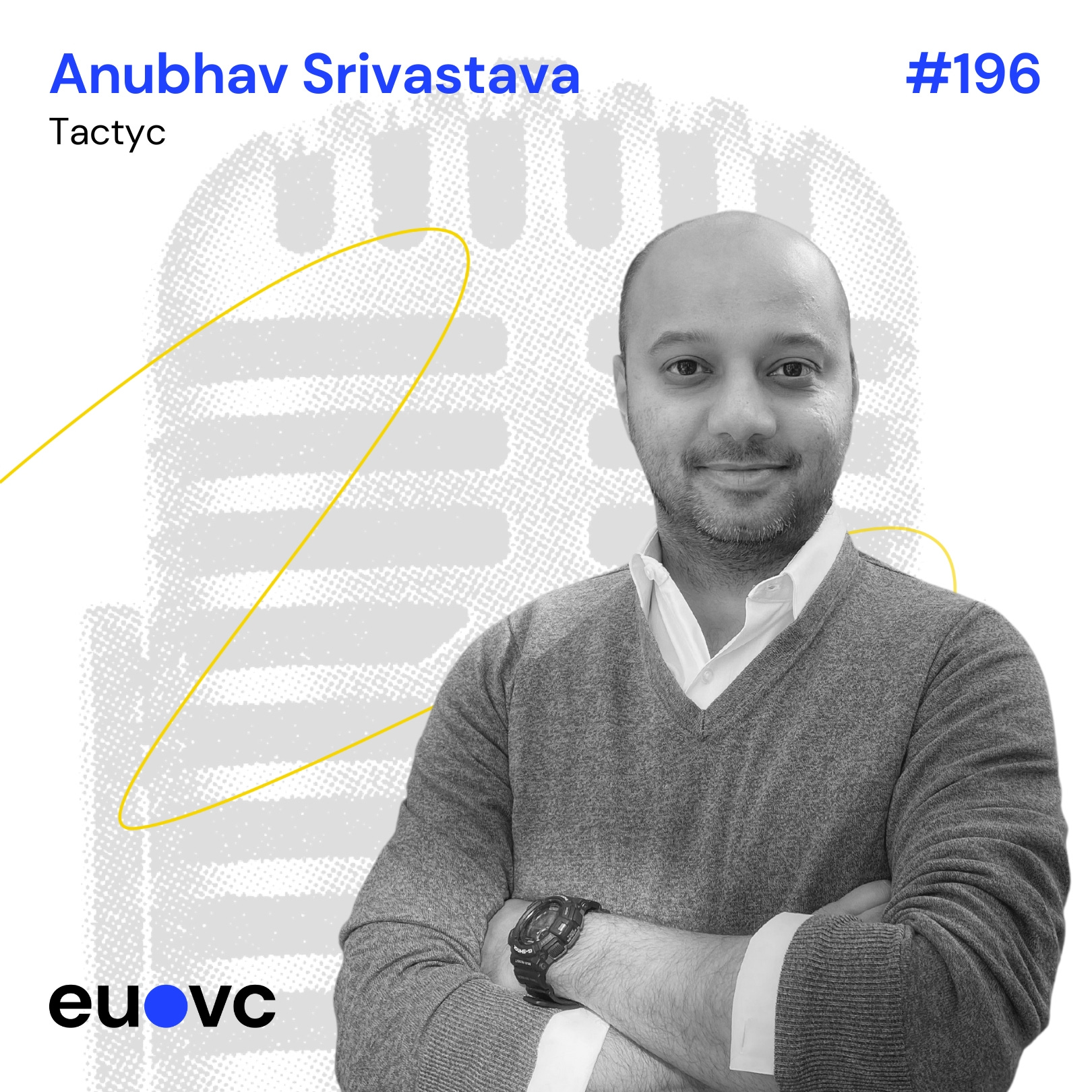
 Anubhav acknowledges [**MaC Venture Capital**](https://link.sbstck.com/redirect/acd960c1-1a64-40f9-a288-77384e9df987?j=eyJ1IjoiMXI2aWl5In0.pWNC5J1SeOjGT6Sb4DuyBCmHNoVwMkb39Artb1RhL1I), particularly [**Michael Palank**](https://link.sbstck.com/redirect/9cd11cba-cfc7-4bbd-9477-53c7a579084f?j=eyJ1IjoiMXI2aWl5In0.pWNC5J1SeOjGT6Sb4DuyBCmHNoVwMkb39Artb1RhL1I), as one of their earliest investors who worked closely with them to develop a robust portfolio construction plan and facilitated key connections within networks.
> ***Michael worked with us extensively to develop a solid portfolio construction plan, and connect us with different networks, such as Kauffman Fellows.***
>
> *A product like Tactyc cannot work in isolation - it has to be built in partnership with VCs. Some of our early clients, such as Tusk Venture Partners, Atomico, Motivate, Munich Re are examples of clients we have worked closely to build a product tailed for VCs.*
Anubhav expresses profound gratitude for the pivot that MaC Venture Capital enabled, highlighting Michael's instrumental role in building the portfolio construction dashboard.
> *We pivoted our company, when we realeased a portfolio construction dashboard.*
>
> *The person who built it was Michael Palank, a GP at MaC Venture Capital. And I couldn't be more grateful for that pivot that he gave us. He has been tremendous for connecting us with the right people, broadcasting about us, and speaking aboit portfolio construction.*
>
> *We’ve done* [*podcasts together*](https://link.sbstck.com/redirect/6b5f71c5-38a4-4909-b42b-5aad8a8c9731?j=eyJ1IjoiMXI2aWl5In0.pWNC5J1SeOjGT6Sb4DuyBCmHNoVwMkb39Artb1RhL1I)*,* [*webinars together*](https://link.sbstck.com/redirect/0cbe9c70-37b0-4900-9056-37765063d372?j=eyJ1IjoiMXI2aWl5In0.pWNC5J1SeOjGT6Sb4DuyBCmHNoVwMkb39Artb1RhL1I)*,* [*blog posts together*](https://link.sbstck.com/redirect/fbbb1c10-d066-473d-9484-003b352566a7?j=eyJ1IjoiMXI2aWl5In0.pWNC5J1SeOjGT6Sb4DuyBCmHNoVwMkb39Artb1RhL1I)*. **I am more than fortunate to have an investor like him. Besides capital, I was extremely lucky to have him guide our product.***
***
### Anubhav’s Three Biggest Learnings
#### **1. Never underestimate the power of small teams.**
Anubhav emphasizes the power of small teams, highlighting their **ability to move mountains quicker than larger incumbents**. He urges founders to leverage this advantage by making faster decisions and shipping products rapidly.
> *They can move mountains quicker than large incumbents by 100x. Use that to your advantage. Make faster decisions, and ship products faster, and larger incumbents will still be stuck under process.*
>
> *I personally conduct every demo of Tactic because it allows me to learn, shape our product strategy, and drive our engineering efforts. If I had additional layers of sales reps or engineers, important details could get lost in translation. Being directly involved enables me to move fast and respond quickly to client needs. I can implement feature requests within hours, ensuring we deliver a seamless experience. That's the strength of a small, agile team.*
#### **2. Focus on controllable - and be cognizant of the risk factors outside your control.**
Anubhav's second learning centers around focusing on controllable and being aware of the risk factors outside one's control. As a founder, he stresses the importance of directing energy toward what can be controlled, such as product development and sales processes.
For VCs, Anubhav believes that while they **cannot control the performance of their portfolio companies,** they can control their portfolio construction and investing strategies.
> *As a founder, this means I focus on our product, our customers, and our roadmap. I cannot control things like (a) competition or (b) whether I can successfully close a sale.*
>
> *I can only focus on our product, our sales process, how we demo the product, and how we communicate the product to the client.*
>
> *In the context of the venture, I’ve realized GPs cannot truly control the performance outcome of their portfolio companies, no matter how great their value-add or diligence process - so the only thing they can control is their portfolio construction (how many deals) and investing strategy (check sizes and reserve strategy).*
#### **3. Ignore the naysayers**
Lastly, Anubhav encourages entrepreneurs to **ignore the naysayers and bias toward action**. He acknowledges that startups rarely have a perfect strategy from day one and advises founders to evolve and adapt their strategies over time.
> *When you're first starting a company, it's mostly just about the passion, about wanting to see a product out in the world. Then the rest of the chips, you figure it out as you go. So, if an investor or someone else is asking you in your first year or what's your competitive mode, ignore it right now.*
>
> *Just **continue building.***
Anubhav's insights serve as invaluable guidance for aspiring founders and VCs alike, reminding them to embrace small teams, focus on what can be controlled, and have the courage to defy conventional wisdom.
> *It’s easy to say when a company will fail (small TAM, lack of competitive moat, etc.)*
>
> *These are things that we are taught as MBAs to evaluate - and it’s easy to “play founder”, but bias to action is rare. Rarely do startups have the perfect strategy from Day 1, instead, the strategy evolves and changes over time to address these questions or perceived weaknesses*
***
###
Anubhav acknowledges [**MaC Venture Capital**](https://link.sbstck.com/redirect/acd960c1-1a64-40f9-a288-77384e9df987?j=eyJ1IjoiMXI2aWl5In0.pWNC5J1SeOjGT6Sb4DuyBCmHNoVwMkb39Artb1RhL1I), particularly [**Michael Palank**](https://link.sbstck.com/redirect/9cd11cba-cfc7-4bbd-9477-53c7a579084f?j=eyJ1IjoiMXI2aWl5In0.pWNC5J1SeOjGT6Sb4DuyBCmHNoVwMkb39Artb1RhL1I), as one of their earliest investors who worked closely with them to develop a robust portfolio construction plan and facilitated key connections within networks.
> ***Michael worked with us extensively to develop a solid portfolio construction plan, and connect us with different networks, such as Kauffman Fellows.***
>
> *A product like Tactyc cannot work in isolation - it has to be built in partnership with VCs. Some of our early clients, such as Tusk Venture Partners, Atomico, Motivate, Munich Re are examples of clients we have worked closely to build a product tailed for VCs.*
Anubhav expresses profound gratitude for the pivot that MaC Venture Capital enabled, highlighting Michael's instrumental role in building the portfolio construction dashboard.
> *We pivoted our company, when we realeased a portfolio construction dashboard.*
>
> *The person who built it was Michael Palank, a GP at MaC Venture Capital. And I couldn't be more grateful for that pivot that he gave us. He has been tremendous for connecting us with the right people, broadcasting about us, and speaking aboit portfolio construction.*
>
> *We’ve done* [*podcasts together*](https://link.sbstck.com/redirect/6b5f71c5-38a4-4909-b42b-5aad8a8c9731?j=eyJ1IjoiMXI2aWl5In0.pWNC5J1SeOjGT6Sb4DuyBCmHNoVwMkb39Artb1RhL1I)*,* [*webinars together*](https://link.sbstck.com/redirect/0cbe9c70-37b0-4900-9056-37765063d372?j=eyJ1IjoiMXI2aWl5In0.pWNC5J1SeOjGT6Sb4DuyBCmHNoVwMkb39Artb1RhL1I)*,* [*blog posts together*](https://link.sbstck.com/redirect/fbbb1c10-d066-473d-9484-003b352566a7?j=eyJ1IjoiMXI2aWl5In0.pWNC5J1SeOjGT6Sb4DuyBCmHNoVwMkb39Artb1RhL1I)*. **I am more than fortunate to have an investor like him. Besides capital, I was extremely lucky to have him guide our product.***
***
### Anubhav’s Three Biggest Learnings
#### **1. Never underestimate the power of small teams.**
Anubhav emphasizes the power of small teams, highlighting their **ability to move mountains quicker than larger incumbents**. He urges founders to leverage this advantage by making faster decisions and shipping products rapidly.
> *They can move mountains quicker than large incumbents by 100x. Use that to your advantage. Make faster decisions, and ship products faster, and larger incumbents will still be stuck under process.*
>
> *I personally conduct every demo of Tactic because it allows me to learn, shape our product strategy, and drive our engineering efforts. If I had additional layers of sales reps or engineers, important details could get lost in translation. Being directly involved enables me to move fast and respond quickly to client needs. I can implement feature requests within hours, ensuring we deliver a seamless experience. That's the strength of a small, agile team.*
#### **2. Focus on controllable - and be cognizant of the risk factors outside your control.**
Anubhav's second learning centers around focusing on controllable and being aware of the risk factors outside one's control. As a founder, he stresses the importance of directing energy toward what can be controlled, such as product development and sales processes.
For VCs, Anubhav believes that while they **cannot control the performance of their portfolio companies,** they can control their portfolio construction and investing strategies.
> *As a founder, this means I focus on our product, our customers, and our roadmap. I cannot control things like (a) competition or (b) whether I can successfully close a sale.*
>
> *I can only focus on our product, our sales process, how we demo the product, and how we communicate the product to the client.*
>
> *In the context of the venture, I’ve realized GPs cannot truly control the performance outcome of their portfolio companies, no matter how great their value-add or diligence process - so the only thing they can control is their portfolio construction (how many deals) and investing strategy (check sizes and reserve strategy).*
#### **3. Ignore the naysayers**
Lastly, Anubhav encourages entrepreneurs to **ignore the naysayers and bias toward action**. He acknowledges that startups rarely have a perfect strategy from day one and advises founders to evolve and adapt their strategies over time.
> *When you're first starting a company, it's mostly just about the passion, about wanting to see a product out in the world. Then the rest of the chips, you figure it out as you go. So, if an investor or someone else is asking you in your first year or what's your competitive mode, ignore it right now.*
>
> *Just **continue building.***
Anubhav's insights serve as invaluable guidance for aspiring founders and VCs alike, reminding them to embrace small teams, focus on what can be controlled, and have the courage to defy conventional wisdom.
> *It’s easy to say when a company will fail (small TAM, lack of competitive moat, etc.)*
>
> *These are things that we are taught as MBAs to evaluate - and it’s easy to “play founder”, but bias to action is rare. Rarely do startups have the perfect strategy from Day 1, instead, the strategy evolves and changes over time to address these questions or perceived weaknesses*
***
###  The Quickfire Round